
Guest post by pharmacist Laura Ploch
Itching as a symptom of mast cell activation syndrome (MCAS) and allergic conditions
When it is hot outside, 95°F and sweat just won't stop, life tends to get harder, not easier, for people with mast cell conditions like mast cell activation syndrome (MCAS) or other skin conditions. Add comorbidities like urticaria (hives, a skin condition involving welts and rashes) and/or atopic dermatitis into the mix, and managing symptoms gets even more complicated.
There are other causes of itching too, jaundice, for example. Itching can also be triggered by kidney failure or even infections. These causes aren't covered in this article, but worth flagging anyway: not everyone who's itchy has MCAS or an allergic condition. 😉
Why does itching happen in mast cell conditions like MCAS?
Mast cells release a range of mediators, histamine, leukotrienes, and many others, some of which still aren't fully understood. Increased activity of these cells plays a role in, among other things, mast cell activation syndrome (MCAS).
In allergic and mast cell conditions, histamine is one of the main tissue hormones responsible for a wide range of symptoms, including swelling (angioedema) and itching. Mediators like histamine also communicate with nerve fibers, which relay sensations like itch to the brain (more on this in the following).
This is why antihistamines are prescribed for severe allergic itching. Antihistamines are medications that prevent histamine from binding to receptors on relevant cells, stopping it from triggering symptoms there. [1]
Communication between mast cells and nerve cells in the skin
Research has also found that mast cells and the nerve cells responsible for sensing itch and pain actually communicate with each other. This communication can set off a negative feedback loop. Mast cell mediators can prompt nerve fibers in tissue to release additional inflammatory molecules called neuropeptides, which in turn cause even more mast cell degranulation.
Degranulation describes the process of mast cells releasing mediators like histamine. Picture it a bit like the mast cell "bursting," spilling its contents, held in tiny internal vesicles, into the surrounding tissue, where they go on to trigger further reactions, including at nearby nerve cells.
In short: according to recent research, communication between mast cells and nerve endings appears to significantly contribute to inflammation and the ongoing sensitization of nerve endings. This sensitization then drives the mast cell activation and inflammation cycle further, creating a loop that is genuinely difficult to break.
Researchers from Minnesota (USA) and Kuopio (Finland) have speculated that this process may also contribute to the development of chronic pain. [2]
The toll of itching and MCAS flares
Dealing with a worsening MCAS flare mentally is one thing. Being nearly at your wits' end from relentless itching that keeps you from sleeping or thinking clearly is another thing entirely.
A helpful mindset can be: "No, I'm not going to let this get to me, because getting worked up genuinely does not help." Instead, relaxation techniques and trying to reach as calm a state as possible can allow the body and mind to recover somewhat, even without enough sleep. Easier said than done, of course.
Below, with input from my pharmacist friend Laura, are my personal best tips for dealing with itching. A quick note: not every MCAS patient is the same, and this list isn't exhaustive. I'll happily keep expanding it, so feel free to leave your own tips in the comments.
Tips for itching in MCAS, salicylate and histamine intolerance, and atopic conditions
These tips may also help with allergy-related itching, itching from urticaria or its specific subtypes like aspirin-induced urticaria, or itching related to salicylate intolerance.
Since everyone is different, the same rule applies throughout: always listen to your own body and gut feeling, and when in doubt, check with your doctor, therapist, or pharmacist.
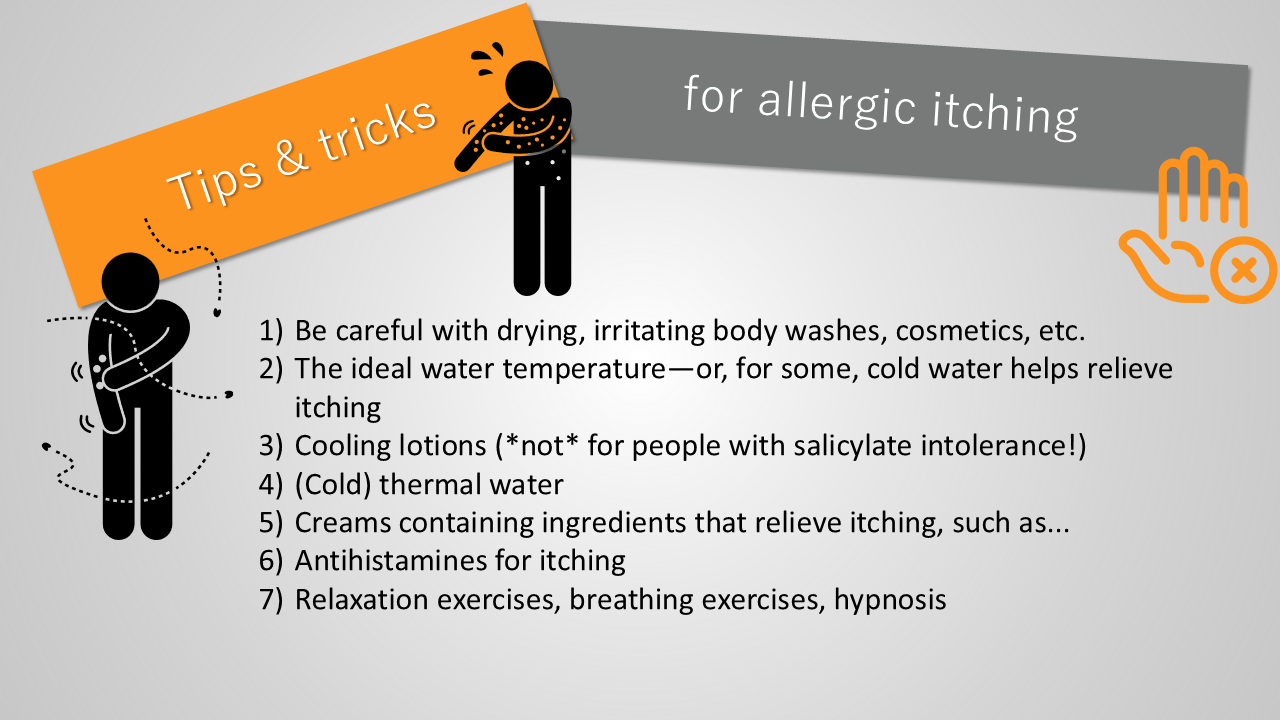
1) Watch out for drying, irritating shower gels, a gentle rinse with lukewarm water is often better
Sweat can be irritating, and beyond that, it just doesn't feel good when everything feels sticky. But shower gels, even specialized ones that are normally well tolerated, can become irritating over time. Listen to your gut here, and when in doubt, plain water on the skin may be the better choice. Lukewarm water helps avoid additional irritation from temperature extremes.
2) For some people, colder water actually works better...
That said, caution is needed with cold-induced urticaria, a specific form of physical urticaria (hives) triggered by cold exposure, which can cause welts, increased itching, and rashes. If this applies to you, it's best to skip the cold water altogether.
It is also worth watching for other symptoms that cold exposure can worsen, Raynaud's phenomenon, for example. This causes the fingers or toes to turn white and then bluish due to a blood vessel spasm. Blood flow then increases again afterward, causing redness that can be quite painful. [3]
My own Raynaud's is fairly pronounced, so cold water really isn't ideal for me, I'm much more of a warm-shower person. 😉 Taking a bath can also help. For some people, baking soda works well, for others it's sea salt (though some might say their sweat is already salty enough). For others, an Epsom salt (magnesium sulfate) bath does the trick. It's worth experimenting to see what works for you.
These products tend to be cheapest through a chemical supplier rather than the wellness aisle, where prices for the same ingredients are often noticeably higher.
3) Cooling lotions, not if you have salicylate intolerance!
I went back and forth on whether to include this one, but cooling creams can genuinely be soothing for people dealing with itching. These usually contain menthol, camphor, or similar ingredients that create a pleasant cooling effect and help ease itch.
Unfortunately, these do not work for me personally, since they often contain menthol, which isn't tolerated well with salicylate intolerance and has triggered serious allergic reactions for me in the past. I'd be especially cautious using these products if you have Samter's triad or salicylate intolerance.
4) Cold thermal spring water, straight from the fridge
This is one of my absolute favorite tricks for itching: easy to control, and no cold fingers involved if you grab the chilled bottle with oven mitts. 😉
There aren't any large-scale studies on thermal spring water yet, and the research that does exist was funded by the manufacturer, so it's worth taking the results with a grain of caution.
What is true: thermal spring water has a different mineral composition than regular tap water. La Roche-Posay thermal spring water, for example, contains notably higher amounts of selenium, which can have a genuinely positive anti-inflammatory and anti-irritant effect on skin. [4] The cooling effect from evaporation can also help ease symptoms like itching or burning.
5) Itch-relieving, skin-calming creams as a base treatment
Look for products free of irritating preservatives or other ingredients you personally don't tolerate well (salicylates, fragrance, benzoates, depending on your sensitivities). A resource list of products meeting these criteria, containing anti-inflammatory ingredients, is available separately.
Some of these contain bisabolol, a now synthetically produced compound derived from chamomile, without the allergenic and irritating potential of the plant itself. Bisabolol has been studied scientifically and shown to positively affect skin inflammation. [5] It also contains no salicylates, which is especially helpful for anyone with salicylate intolerance.
Creams with allantoin can also help with itching. Allantoin's precursor is urea, which is more widely known and commonly found in creams for dry skin. Allantoin also has anti-inflammatory properties, as shown, for example, in a study with psoriasis patients. [6]
6) Antihistamines for itching
Antihistamines can help both MCAS patients and people dealing with other allergic reactions. Most MCAS patients are likely already taking them. Any dose increase or additional antihistamine should always be discussed with a doctor first. During periods of heightened mast cell activity, avoiding known triggers as much as possible is key to getting back to a calmer baseline sooner.
If itching is disrupting sleep, this is also worth discussing with a doctor, since older-generation antihistamines, which tend to be more sedating, can sometimes be used short term specifically to help with sleep, essentially putting their usually unwanted drowsiness side effect to good use.
7) Relaxation techniques, breathing exercises, hypnosis, and visualization for itching
It is admittedly hard to focus on your breath, or attempt anything resembling meditation, in moments when all you want to do is claw at your own skin. Meditation might genuinely be asking too much in that moment. But as mentioned above, it's not particularly helpful to spiral into a cycle of getting worked up about the itching, not being able to sleep because of it, and then getting even more frustrated about not sleeping.
This is where relaxation techniques can help. YouTube and the wider internet offer plenty of guided Jacobson progressive muscle relaxation sessions, which can help redirect focus toward other physical sensations, away from the itching, through deliberate muscle tensing and releasing.
If that feels more irritating than helpful, try consciously directing focus to your breath instead, possibly incorporating specific breathing exercises. Deep belly breathing can help, for example by consciously breathing into your hands placed on your stomach, or through what I call "counting breath."
With this last method, you breathe in for four seconds, hold for seven seconds, and breathe out over eight seconds. If holding your breath feels too difficult, for instance if you have asthma or another condition that makes this uncomfortable, you can instead breathe in for four seconds and breathe out for twice as long, eight seconds.
It can help with falling asleep to try breathing in a little less deeply with each breath, while letting each exhale run a little longer. (This shouldn't feel uncomfortable, though, since that would work against the relaxing effect we're going for.)
A personal sleep tip from Laura: lie on your back, stretch your arms and legs away from your body, and focus on holding that stretch, the effort itself tends to make you sleepy. 😉
8) Self-hypnosis and hypnosis
Hypnosis has proven helpful for both sleep disturbances and itching, in atopic dermatitis, for example. A separate article covers the effects of hypnotherapy on histamine-mediated conditions in more depth. It's genuinely impressive how much this approach can, in some cases, positively influence the course of the condition itself.
What are your experiences?
What helps you most with itching? Share it in the comments, we'd love to keep expanding this list. Thank you!
References
[1] Nowak DA, Yeung J. Diagnosis and treatment of pruritus. Can Fam Physician. 2017;63(12):918-924.
[2] Gupta K, Harvima IT. Mast cell-neural interactions contribute to pain and itch. Immunol Rev. 2018;282(1):168-187. doi:10.1111/imr.12622
[3] Pschyrembel. Raynaud-Syndrom. Last accessed: 22.07.2026. https://www.pschyrembel.de/Raynaud-Syndrom/B17NU
[4] Seite S. Thermal waters as cosmeceuticals: La Roche-Posay thermal spring water example. Clin Cosmet Investig Dermatol. 2013;6:23-28. doi:10.2147/CCID.S39082
[5] Maurya AK, Singh M, Dubey V, Srivastava S, Luqman S, Bawankule DU. α-(-)-bisabolol reduces pro-inflammatory cytokine production and ameliorates skin inflammation. Curr Pharm Biotechnol. 2014;15(2):173-181. doi:10.2174/1389201015666140528152946
[6] Rashidi I, Rad MS, Bakhsh AK, Rezazadeh T. Evaluation of the use of allantoin for reducing inflammation in the skin of patients with psoriasis. Journal of Clinical & Experimental Dermatology Research. doi:10.4172/2155-9554.C1.051