

Guest post by Lisa Dostmann
Relationships aren't always easy, even under normal circumstances. Two people who think, feel, and love differently choose to enrich each other's lives while also making compromises along the way. Those compromises can feel especially large when one partner becomes chronically ill. It often turns even a previously well-functioning relationship upside down.
As a therapist living with a chronic illness myself, I see this play out not just with patients, but in my own relationship too, which has had to adapt, and continues to adapt, to the limitations my illness brings. Here are my tips for how a happy relationship can work for both partners.
"My husband (or wife) can't handle the fact that I'm sick"
This statement often comes from people with chronic illness who are in a relationship that began before the illness did, and who now can't fulfill the role they once had. Future plans have to change, or sometimes can't happen at all. Chronic illness puts real strain on a relationship in a fundamental way. Often, it's not just the partner who struggles with this new reality, a person's own sense of identity and self-perception takes a hit, too.
So the statement "my husband or wife can't handle the fact that I'm sick" is probably at least partly true. But can you really blame your partner for that? Can I say I handle my own chronic illness well? Am I not also grieving my old life, and dealing with my own fears about the future? As a couple, you might actually be closer in your thinking than you realize, everyone just expresses their own helplessness differently.
And the real question is: what does "can't handle it" actually mean?
One important caveat first: if someone becomes abusive, physically or emotionally, shows aggression, or applies pressure, that's always a valid reason to end a relationship. That behavior signals a fundamentally flawed idea of what an equal, healthy relationship looks like, and it crosses a clear line.
That said, it's unrealistic to expect that a major, illness-driven shift in daily life (and possibly financial circumstances too) leaves a partner completely unaffected. It's not just extreme situations, like the death of a family member, that leave real wounds, job loss or the illness of someone you love can too. So it's understandable if the emotional resilience of the healthy partner wavers at times.
When you're the one living with the illness, dealing with real pain and fear about the future, it can be genuinely hard to put yourself in your partner's shoes, since they seem, at first glance, to be only peripherally affected. They're often "healthier," without a chronic illness or chronic pain of their own. But sometimes it helps to imagine things from the "healthy" partner's side, and ask yourself how you'd feel if someone you loved suddenly became seriously ill or started living with severe pain.

Tip 1: Exchange thoughts and assumptions without judgment, with a helpful exercise
We often mistakenly believe we can read our partner and know exactly what they're thinking. This leads us to interpret their actions through the lens of our own assumptions about their thoughts, which gets pretty tangled, doesn't it?
A helpful exercise is writing down what you think is going through your partner's mind. This shifts the focus onto your partner, and afterward, you can swap what you've each written. It's also a great way to challenge the "you should just know what I'm thinking" assumption we often fall into, more or less unconsciously.
You might even see your partner differently once you notice how much they've actually been thinking about something you personally found less distressing or significant. Overall, this exercise tends to create a solid foundation for conversation, one that can help bring you back toward each other.

Tip 2: Acknowledge each other's pain
It matters that both partners acknowledge each other's pain, even when the healthy partner isn't experiencing physical pain in the direct sense. The "healthy" partner is also going through something genuinely difficult, especially if they truly love you. When the person you want to share your life with becomes ill, that hits very differently than if it were a more superficial relationship or acquaintance, one that maybe already had an "expiration date" and wasn't going to lead to growing old together or starting a family.
It's also important for the healthy partner to understand that pain and fear can make the person they love seem, at times, seemingly irrational or simply different than usual. Priorities shift quickly when something genuinely hurts. This calls for patience and understanding, even when that's difficult for the healthy partner too.
Tip 3: Give each other breaks and space
Being there for each other also requires giving each other breaks and space. It can be genuinely painful for the partner who, because of illness, can no longer participate in social life the way they used to, to stay home alone while their partner goes out and has fun with old friends.
I think it's especially important to give the "healthy" side of the relationship this kind of space, without holding it against them afterward with something like: "I let you go do that, so now you owe me this or that." Compassion, in the true sense, taking joy in your partner's joy, would be far more enriching for both of you. (And yes, I know that's not always easy.)
The reverse holds true just as much. When your partner is completely exhausted and in pain on the couch, that's not the moment to bring up deep relationship issues or point out perceived mistakes.
You love each other, and you want good things for your partner, right? So it's important to communicate openly about what you actually need right now, what you can handle, and what you can't. To use an example from my own relationship: most of the time, I simply can't "keep up." What I'm able to manage day to day is far from what you'd typically expect from a "normal" 30-year-old.
But I also can't expect my partner to live a life I wouldn't have chosen for myself either, if I were healthy. That would be unfair. And yes, it's okay to feel angry sometimes, even more than once. Just make sure your partner doesn't become the target for the fact that life isn't always fair.
Even so, I have genuinely bad days too, days when it really matters to me that my partner is physically there with me, or when I need moral or physical support. That's where give and take comes in too: if your partner stays home for you, you shouldn't have to feel guilty about it.
Learning to correctly interpret these needs takes real work: why don't I want to allow certain things (for myself or my partner), or why can't I accept certain things? Communication plays a huge role here, which brings me to the next point.
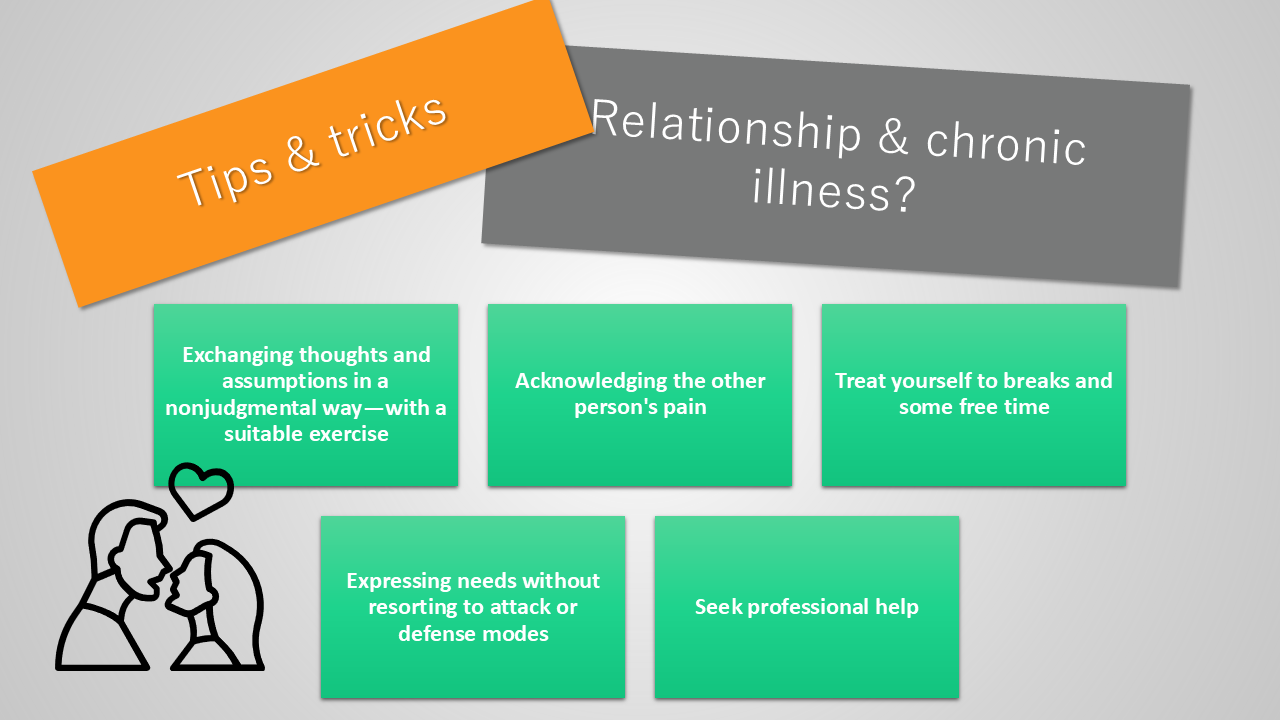
Tip 4: Communicate needs without slipping into attack-and-defend mode
Communicating needs "correctly" isn't always easy, because for them to land the way you intend, you first need to get on the same wavelength. What do I mean by that?
Clearly communicating needs requires the right foundation first. Otherwise, newly introduced communication strategies can backfire, either getting misunderstood or used as a weapon to hurt the other person. As in: "Well, since we're being honest here, let me tell you everything about you that's always bothered me."
It's important to avoid "you" statements and use "I" statements instead. So not "you should," but "I wish for this, I see our future this way." Just be careful not to turn "I" statements into "I want you to do this or that," that's not really an "I" statement, it's just a more politely disguised "you" statement.
If we genuinely want to communicate honestly about our needs as a couple, that will inevitably mean bringing up some uncomfortable topics too, and that's a good thing. What matters is accepting the other person's needs and opinions without treating them as a malicious accusation, and instead trying to respond constructively. That means asking for clarification, checking whether you've understood something correctly, before reacting strongly. Here too: tone matters, for both sides.
In some relationships, communication patterns have become too entrenched, and the wounds run too deep. In those cases, professional support is often the only real path forward.
Tip 5: Seek professional support
Seeking professional help isn't a weakness, quite the opposite. Sometimes it's exactly what a couple needs to move forward. This is worth weighing together, honestly:
Does the relationship as a whole need support, or is one partner struggling so much with the illness that they may already be showing signs of depression?
Being honest with each other here matters, and there's no shame in drawing on outside resources. Individual therapy in particular can help someone come to terms with a significantly changed set of circumstances. Self-worth can take a real hit too, which is why this is covered in more depth in a separate article.
I wish every couple facing changed circumstances the courage and strength to work through them together. In some ways, these changes might even turn into an opportunity, a chance to bring a relationship to a new level of intimacy and closeness.
Did I miss anything? What has your experience been?