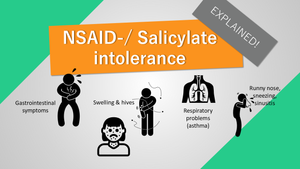
When food triggers breathing difficulties, asthma attacks, or hives, and standard allergy testing comes back negative, it is worth considering organic acids like salicylic acid as a possible cause, alongside the usual suspect, histamine.
Salicylate intolerance, also called NSAID intolerance, is a sensitivity to salicylic acid and non-steroidal anti-inflammatory drugs (NSAIDs), which include aspirin, ibuprofen, and diclofenac. Since this is still a relatively unfamiliar condition, both to patients and to many clinicians, it is worth covering in detail.
Salicylates are found in nearly all plants, particularly herbs, berries, and many plant oils (coconut oil, olive oil). They are widely considered healthy, and some research has speculated that part of the benefit associated with a diet rich in fruit, vegetables, and spices may come from this very molecule.
This article aims to give a broad overview of salicylate and NSAID intolerance, rather than focusing solely on the better-known Samter's triad (also called Samter's disease or Widal's disease). Samter's triad, consisting of recurring nasal polyps or chronic sinusitis, asthma, and intolerance reactions to aspirin, has considerably more research behind it and will be covered in a separate article.
One cause of salicylate intolerance: disrupted arachidonic acid metabolism
In salicylate intolerance, taking anti-inflammatory substances like aspirin shifts fatty acid metabolism, leading to excess production of pro-inflammatory mediators such as leukotrienes. These can trigger allergy-like symptoms in affected individuals, including a runny nose and swelling. Since these mediators have wide-ranging effects throughout the body, the resulting symptom picture is fairly extensive. [1]

Leukotrienes promote mucus production and airway constriction, which can trigger asthma attacks in sensitive individuals. (Find more here.)
Prostaglandins can have either pro-inflammatory or anti-inflammatory effects, depending on the specific type. They are involved in pain and inflammation and are suspected of contributing to flushing (a sudden reddening of the skin) and possibly the "brain fog" sometimes reported by patients with mast cell activation syndrome. [2]
A "shift" in arachidonic acid metabolism
Aspirin and other pain relievers like diclofenac (Voltaren®) or ibuprofen block prostaglandin production, a byproduct of arachidonic acid metabolism, by inhibiting the cyclooxygenase (COX) enzymes. [3]
Because this COX pathway is blocked, arachidonic acid breakdown shifts toward an alternative route via the lipoxygenase (LOX) pathway instead. This leads to a sharp increase in leukotriene production, which promotes inflammation and increased vascular permeability. Along with the respiratory symptoms already mentioned, this can also cause swelling (angioedema, hives), as seen in aspirin-induced urticaria. [1] [4]
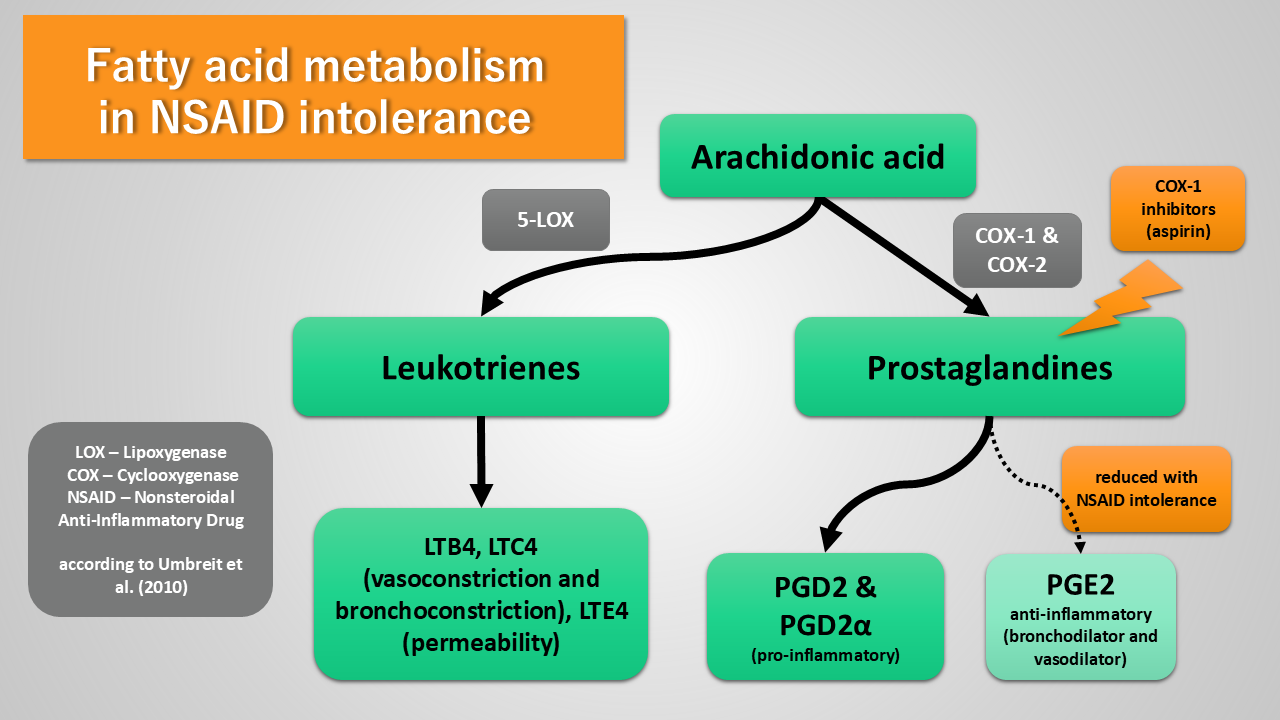
Since blocking the cyclooxygenases, particularly COX-1, is what drives this shift, essentially all COX-1 inhibitors, including diclofenac, ibuprofen, and naproxen, and not just aspirin, tend to be problematic for affected individuals.
The changes in prostaglandin receptors in people with Samter's triad and the role that the bacterium Staphylococcus aureus may play in this process are discussed in detail in a separate article on the causes.
Symptoms of salicylate intolerance
The surge of pro-inflammatory mediators, particularly the leukotrienes described above, can cause the following symptoms:
- Asthma attacks and bronchospasm
- Skin swelling (angioedema) and hives
- Itching
- Sudden flushing
- Runny nose (rhinitis) and swollen nasal mucosa
- Sinusitis
- Nasal obstruction
- Gastrointestinal symptoms
- Drop in blood pressure and shock (in severe cases)
Gastrointestinal symptoms during an acute episode can include bloating, diarrhea, cramping pain, and colitis. Localized swelling in the intestinal wall can also occur, which tends to cause constipation rather than diarrhea in some patients. In later, chronic stages, this ongoing inflammation can lead to strictures or fibrosis, structural changes in the intestinal tissue. [5]

Many affected individuals also notice tinnitus on exposure. Symptoms can range from mild to, in rare cases, severe anaphylactoid reactions.
These reactions are called anaphylactoid rather than anaphylactic, since NSAID intolerance is not mediated by specific antibodies (IgE), unlike a true allergy.
Salicylate intolerance in the scientific literature
Salicylate intolerance beyond the classic Samter's triad picture (asthma, polyps, and sometimes hives) is still covered in relatively few scientific publications. Alongside respiratory symptoms, it has been linked to gastrointestinal complaints, concurrent food allergies, and inflammatory bowel conditions like ulcerative colitis.
A 2005 study by Raithel et al. found salicylate intolerance in 5.9% of patients with gastrointestinal allergies and 7.4% of participants with ulcerative colitis (UC). Of the salicylate-intolerant UC patients, 40% also had symptoms when taking mesalazine, an anti-inflammatory medication commonly used to manage UC that happens to be an amine derivative of salicylic acid.
Organic acid intolerance often co-occurs with salicylate intolerance
Patients with a sensitivity to salicylic acid frequently also react to other organic acids that are structurally similar to it, benzoic acid or certain dyes like tartrazine, for example. [5]
Organic acid intolerance is often grouped under the term phenol intolerance, since these organic acids belong to the phenol group.
Dr. Janice Vickerstaff Joneja, a food allergy expert and author of comprehensive resources such as The Health Professional's Guide to Food Allergies and Intolerances, holds that symptom control is usually achievable with an allergen-free diet, combined with a low-histamine approach that also avoids benzoates (found in berries, for example) where needed. In clinical practice, however, this tends to work only when salicylate intolerance is not present at the same time.

The connection between salicylate and histamine intolerance
Salicylate intolerance, in its various forms, including aspirin-induced urticaria, has also been associated with genetic variants in histamine metabolism, specifically DAO and HNMT polymorphisms. [6] [7]
Histamine breakdown in the body, and how genetics can affect it, is covered in detail in the article on the causes of histamine intolerance.
It is therefore not surprising that, in clinical practice, histamine intolerance and sensitivity to organic acids like salicylic acid are often seen together.
Salicylate intolerance: a contested area?
There is some ongoing debate in the research community about whether dietary salicylic acid can meaningfully influence arachidonic acid metabolism enough to cause clinical symptoms. Growing understanding of mast cells and mast cell disorders may offer part of the explanation.
That said, randomized controlled studies in patients with Samter's triad or aspirin-induced urticaria clearly show that symptoms and disease burden decrease significantly with a reduction in dietary salicylates. [8]
Diagnosis
NSAID intolerance can be diagnosed through an oral provocation test. This should only ever be carried out under experienced medical supervision, given the potential for severe, life-threatening reactions. Attempting this at home is strongly discouraged.
Functional eicosanoid testing can also support diagnosis. Less specific markers, such as urinary leukotrienes and methylhistamine, are best tested over several days on a hypoallergenic rice-based diet to establish a reliable baseline.
Treatment
Treatment should be tailored to the severity and specific presentation of the condition. A low-salicylate, omega-3-rich diet is often a good foundation, while making sure nutrient intake remains adequate and the diet isn't restricted more than necessary. [8] [9] [10]
Given the complexity of treatment, this is covered in more detail in a separate article.
Case study from clinical practice
A patient presented with recurring severe swelling, medically known as angioedema, that occurred repeatedly in the evenings, not just in the face but also in the extremities. She had been under allergy specialist care for some time and had undergone multiple prick tests without any conclusive results. Despite this, she felt her food choices were somehow connected to the angioedema episodes, though she could not identify a clear pattern.
Given the significant impact on her quality of life and the lack of response to high-dose antihistamines, a doctor suggested trying a low-histamine diet, since this helps some patients. In the meantime, she had already tried up to four times the maximum daily dose of various antihistamines without success.
After a full year of an unsuccessful low-histamine diet, the patient sought further evaluation, at which point it emerged that her angioedema had first appeared after taking aspirin. It also became clear that the swelling often was not linked to meal timing, but occurred after showering and skincare routines.
Due to acne-prone skin, she had been using creams containing salicylic acid, which she was advised to discontinue. This change in skincare products alone led to a noticeable reduction in symptoms. [By the way: You can find a list of salicylate-free cosmetics here, as well as a list of salicylate-free personal care products.]
To rule out other allergic processes, particularly food-related ones, a provocation test was carried out following the protocol developed by Prof. Raithel in Erlangen.
This involved a 24-hour urine collection under a rice-only diet and then under a normal diet, testing for excreted methylhistamine. This showed no significant abnormality. Urinary leukotriene levels, however, were clearly elevated, and rose specifically on the day the patient experienced swelling again and had eaten a relatively high-salicylate diet.
A C1 esterase inhibitor deficiency was also ruled out, given the severity of the angioedema and its occurrence in atypical locations such as the arms and legs. C1 inhibitor deficiency causes bradykinin-mediated rather than histamine-mediated angioedema, which doesn't respond to antihistamines. This condition is rare and can be either inherited or acquired.
Following a reduction in dietary and skincare-related salicylates, combined with improving the patient's omega-3 status, her condition improved. She was also referred to a specialist to evaluate whether leukotriene receptor blocker therapy with montelukast might be appropriate, based on the current evidence and treatment guidelines for urticaria. [11] [12]
Adding montelukast reduced the frequency of her swelling episodes from multiple times a week, sometimes daily, down to roughly once a month.
Conclusion
Salicylate intolerance is an often underrecognized condition that can significantly affect quality of life. It likely results from a combination of disrupted fatty acid metabolism and disproportionate mast cell activation.
Further research is needed to clarify the role of the MRGPRX2 receptor on mast cells. It would also be worth investigating whether IgE antibodies against Staphylococcus aureus enterotoxin, frequently found in nasal polyps and the associated Th2 inflammation, also play a role in salicylate intolerance.
References
[1] Kirsche H, Klimek L. ASS-Intoleranz-Syndrom und persistierende Rhinosinusitis. HNO. 2015;63(5):357-363. doi:10.1007/s00106-015-0008-7
[2] Lee MJ, Akin C. Mast cell activation syndromes. Annals of allergy, asthma & immunology : official publication of the American College of Allergy, Asthma, & Immunology. Published online 2013. doi:10.1016/j.anai.2013.02.008
[3] Umbreit C, Klimek L, Pfaar O. Das ASS-Intoleranz-Syndrom. Das ASS-Intoleranz-Syndrom (M. Samter, M. Widal) – Ursache für Nasenpolypen, Asthma bronchiale und Urtikaria. Accessed July 20, 2026. https://allergiezentrum.org/infos-fuer-aerzte/das-ass-intoleranz-syndrom/
[4] Li KL, Lee AY, Abuzeid WM. Aspirin Exacerbated Respiratory Disease: Epidemiology, Pathophysiology, and Management. Medical Sciences. 2019;7(3):45. doi:10.3390/medsci7030045
[5] Raithel M, Baenkler H, Naegel A, et al. Significance of salicylate intolerance in diseases of the lower gastrointestinal tract. Journal of physiology and pharmacology : an official journal of the Polish Physiological Society. 2005;56:89-102.
[6] Agúndez JAG, Ayuso P, Cornejo-García JA, et al. The Diamine Oxidase Gene Is Associated with Hypersensitivity Response to Non-Steroidal Anti-Inflammatory Drugs. PLoS One. 2012;7(11). doi:10.1371/journal.pone.0047571
[7] Kim SH, Kang YM, Cho BY, Ye YM, Hur G, Park HS. Histamine N-methyltransferase 939A>G polymorphism affects mRNA stability in patients with acetylsalicylic acid-intolerant chronic urticaria. Allergy. 2009;64:213-221. doi:10.1111/j.1398-9995.2008.01795.x
[8] Kęszycka PK, Lange E, Gajewska D. Effectiveness of Personalized Low Salicylate Diet in the Management of Salicylates Hypersensitive Patients: Interventional Study. Nutrients. 2021;13(3):991. doi:10.3390/nu13030991
[9] Schneider TR, Johns CB, Palumbo ML, Murphy KC, Cahill KN, Laidlaw TM. Dietary Fatty Acid Modification for the Treatment of Aspirin-Exacerbated Respiratory Disease: A Prospective Pilot Trial. J Allergy Clin Immunol Pract. 2018;6(3):825-831. doi:10.1016/j.jaip.2017.10.011
[10] Healy E, Newell L, Howarth P, Friedmann PS. Control of salicylate intolerance with fish oils. British Journal of Dermatology. 2008;159(6):1368-1369. doi:10.1111/j.1365-2133.2008.08830.x
[11] Pérez C, Sánchez-Borges M, Capriles E. Pretreatment with montelukast blocks NSAID-induced urticaria and angioedema. Journal of Allergy and Clinical Immunology. 2001;108(6):1060-1061. doi:10.1067/mai.2001.120275
[12] Alkeraye S, AlRuhaimi DK. The Addition of Montelukast for the Treatment of Chronic Idiopathic Urticaria. Cureus. 2021;13(7). doi:10.7759/cureus.16137