Choline for POTS and brain fog
When someone in clinical practice mentions taking citicoline or alpha-GPC, it is almost always because of brain fog, or a wish to influence an autonomic nervous system that is usually out of balance. With POTS and dysautonomia, that is an obvious thought, since the autonomic nervous system is demonstrably disrupted in many conditions like ME/CFS, long COVID, POTS, and the whole "alphabet soup," with the sympathetic branch often overactive.
So logically, you want to "strengthen" the other side, in this case the parasympathetic branch, and acetylcholine is the transmitter of the parasympathetic nervous system. The mechanistic thought behind it is essentially: if you increase acetylcholine, surely that should help?
The question, of course, is whether that is a mechanism that actually works. And because the TMAO discussion is running in parallel, which scares a lot of people, it is worth looking at both together. (Aside: TMAO, short for trimethylamine-N-oxide, is produced when choline is taken and was suspected of triggering cardiovascular disease.) It would be bad to buy yourself a real risk in exchange for an unproven benefit.
One more note upfront: choline, phosphatidylcholine, citicoline (CDP-choline), and alpha-GPC are not the same thing. They all deliver choline, but differ in their absorption and risk profile. They are nonetheless treated together here.
Citicoline = CDP-choline = cytidine-5′-diphosphocholine; alongside choline, it also delivers cytidine, from which the body forms uridine, which is likewise a building block for cell membranes.
Choline in the body: a methyl donor
Choline is a vitamin-like nutrient and a methyl donor (via betaine, see below). Choline therefore offers a further way to remethylate homocysteine to methionine and thereby lower homocysteine, which is associated, for example, with an increased stroke risk. Phosphatidylcholine, a bound form of choline, is an important component of cell membranes and is also widely marketed as a supplement.
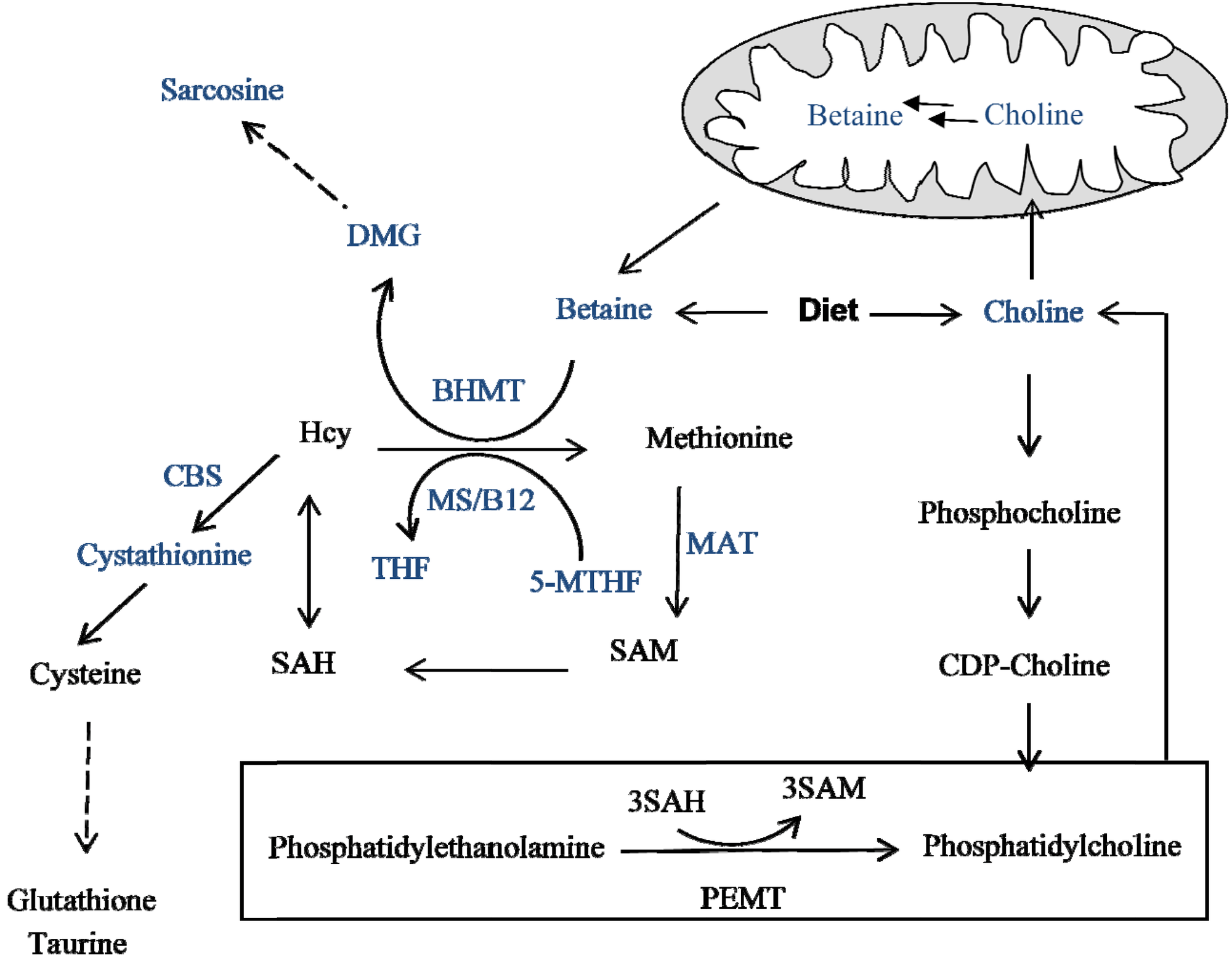
Choline itself does not donate a methyl group. In the mitochondria of the liver and kidney, it is first oxidized via choline dehydrogenase to betaine aldehyde and then further to betaine (trimethylglycine). Betaine carries three methyl groups, and the enzyme BHMT (betaine-homocysteine methyltransferase) transfers one of them onto homocysteine: this produces methionine, and from that SAMe, the body's universal methyl group donor.
This is therefore the second, folate-independent way to "dispose of" homocysteine. The better-known one runs via methylfolate (5-MTHF, the active form of folate) and vitamin B12. Anyone with limitations at this point, for example through MTHFR gene variants, so-called polymorphisms, or a B12 deficiency, relies more heavily on the betaine pathway.
Whatever has been oxidized to betaine is no longer available for acetylcholine formation or for cell membranes. The methylation function and the nerve function therefore compete for the same choline.
Below is the methylation cycle shown schematically, from Obeid in Nutrients 2013.
Side effects of choline: fishy body odor, sweating, salivation
High doses of choline (several grams per day) lead to a fishy body odor: this is due to trimethylamine, which is then formed above all through the metabolism of choline by gut bacteria. In addition, nausea and vomiting can occur, increased salivation, as well as increased sweating. This is where an overshooting reaction of the parasympathetic nervous system shows up.
Please keep this last point in mind, it becomes important in the POTS section shortly.
Choline in POTS and dysautonomia: what the cholinergic approach can and cannot do
That brings us to the point that leads most of our community to these substances in the first place.
There is a cholinergic anti-inflammatory reflex. The vagus nerve releases acetylcholine, this binds to the alpha-7 nicotinic acetylcholine receptor on macrophages and other immune cells, and there it throttles the production of pro-inflammatory cytokines. This is one of the reasons vagus stimulation is even being investigated as a therapeutic approach.
In POTS, there is actually intervention data. Pyridostigmine, an acetylcholinesterase inhibitor, increases the availability of acetylcholine at the relevant receptors and thereby the parasympathetic tone, or "vagal tone." In a randomized cross-over study with 17 POTS patients, in which each person received both the active drug and the placebo in sequence, a single dose of 30 mg significantly lowered standing heart rate compared to placebo, and the symptom burden decreased more than under placebo. Blood pressure did not change. (Circulation 2005)
So the community's experience is not pulled out of thin air. Targeting the cholinergic system in POTS works.
Pyridostigmine (Mestinon) versus choline, and an interesting single case
Pyridostigmine inhibits the breakdown of acetylcholine. Choline, citicoline, and alpha-GPC deliver building material for its production.
With an enzyme inhibitor like pyridostigmine, the effect is inevitable, because when the enzymatic breakdown is blocked, the concentration that can act on the relevant receptor rises. With administration of a precursor, an increase in concentration can only be achieved if the availability of this building block was the limiting factor beforehand. And with people on a halfway "normal diet," that is mostly rather not the case... apart from special groups like postmenopausal women and MCAS patients who eat only a very restricted diet.
A targeted search for a study showing that choline, citicoline, or alpha-GPC improves standing heart rate and symptom burden in POTS or dysautonomia turns up nothing so far. But:
Schenkel and colleagues described a 28-year-old POTS patient in 2015 whose choline and betaine were low in the blood. In her skin cells, the choline transporter CTL1/SLC44A1 was markedly reduced, and with it choline uptake was reduced by 60 percent. Her mitochondria also worked less well (FASEB J 2015). So exactly the case described above, where the building block was missing...
The patient additionally took 750 mg of choline per day, but her blood values barely rose. What did improve were the cells in the culture dish. In a 2022 podcast, however, it is said that she has continued supplementing since 2014 and feels better for it. She reportedly has more energy and less tachycardia, see here (Standing up to POTS, episode 82).
That is an experience report from a single person over years, and as far as can be seen, this unfortunately was not researched further. For anyone with POTS considering choline, it is worth having choline and betaine measured in the blood and discussing the result with a professional. An elevated homocysteine without vitamin deficiencies, as was present in this patient, could also be an indication.
Phosphatidylcholine in MCAS: what is supported and what is not
Quite a bit circulates about phosphatidylcholine in MCAS, especially in connection with intravenous use, on platforms like Reddit and Facebook. In terms of solid sources, there is essentially a single case report on intravenous phosphatidylcholine in treatment-refractory MCAS (with, honestly, almost unremarkable mediator measurements), plus material from manufacturers of the relevant products.
Controlled studies on phosphatidylcholine in MCAS do not exist.
A further reason for caution with our group: there are reports of angioedema worsening markedly under acetylcholinesterase inhibitors used for POTS. Because acetylcholine does not only influence mast cell degranulation in a dampening way, as is often thought. Cholinergic urticaria is not an established dermatological condition for nothing, one in which acetylcholine-mediated stimuli trigger wheals. Whether choline supplements have any influence on this has, to date, never been investigated.
An interesting side finding: in a portion of those affected by an autonomic disorder, antibodies against the alpha-3 subunit of the ganglionic nicotinic acetylcholine receptor are found. These are detectable in roughly half of cases of autoimmune autonomic ganglionopathy, and it is debated whether a portion of idiopathic POTS cases represents a mild form of it (Neurol Neuroimmunol Neuroinflamm 2022). This suggests that cholinergic transmission, or the "choline-dependent system," is indeed disrupted for genetic or autoimmune reasons in a portion of our community.
Alpha-GPC and stroke risk?
Alpha-GPC (L-alpha-glycerylphosphorylcholine) is the choline form with the highest choline content, around 40 percent of its weight is choline. It reaches plasma choline levels roughly twice as high as citicoline at a comparable dose. This is precisely why it is most heavily marketed in the nootropics and fitness scene.
In 2021, a cohort study from the Korean health insurance database appeared in JAMA Network Open. The starting population was around 12 million people aged 50 and over without pre-existing stroke and without Alzheimer's. After adjusting for all variables, alpha-GPC users had a higher ten-year risk for:
- Total stroke: aHR 1.43 (95% CI 1.41 to 1.46)
- Ischemic stroke: aHR 1.34 (1.31 to 1.37)
- Hemorrhagic stroke: aHR 1.37 (1.29 to 1.46)
And in a dose-dependent way. As a possible mechanism, the authors discuss precisely the TMAO axis, which we will get to shortly.
The aHR is a risk ratio after known risk factors like age, blood pressure, or diabetes have been factored out. 1.0 would mean no difference, 1.43 means a 43 percent higher risk. The range in parentheses is the confidence interval, the span within which the true value very likely lies. If this span does not include 1.0, the finding is considered "statistically significant," meaning solid in the sense of "not explainable by chance." At 1.41 to 1.46, that is clearly the case.
This is, however, a retrospective analysis of insurance data and explicitly not a randomized study.
An obvious objection is that what was measured here was not the effects of the substance at all, but the reason it was prescribed. In Korea, alpha-GPC is prescribed for cognitive complaints (we will get to that evidence below). Cognitive complaints in old age are very often partly vascular in origin, that is, caused by vascular damage that can itself already lead to stroke.
So it could well be that the substance only indicates part of the risk rather than causing it. In technical terms, this problem is called confounding by indication, and it is the classic weakness of such database analyses.
...and yet a choline effect on cognitive performance after all?
A nationwide longitudinal study from South Korea in 2025 found a connection between alpha-GPC use and the delay of manifest dementia when a mild memory impairment is already present.
What is interesting is that the same study also evaluated strokes as a secondary endpoint, with an HR of 0.833 for ischemic and 0.847 for hemorrhagic stroke. The difference from the 2021 study does not lie with the users, since in both cases these are people prescribed alpha-GPC for cognitive complaints. However, the comparison group was different in each case: in 2021, matching was done for age, sex, income, and comorbidities, but not for cognitive status. The controls were therefore predominantly people without memory problems.
In 2025, users and controls all had the same diagnosis. As soon as you compare it that way, the stroke signal disappears. The 2021 authors themselves write that their users were older and sicker and may have already had subclinical vascular changes.
The contradiction cannot be fully resolved...
Based on this, alpha-GPC looks like the most problematic substance of this group as long as the suspicion is not cleared up, particularly for relatively healthy people who "only" want to boost cognitive performance and are already getting enough choline anyway.
TMAO warnings, looked at differently
What then came up was the discussion of whether higher doses of choline, phosphatidylcholine, and also L-carnitine lead to an increased risk of heart disease and cardiovascular events via the production of trimethylamine and TMAO. This concern has by now reached almost every health guide, and it is the point where the most has changed recently, which is why it is worth going into in more detail here.
TMAO and kidney function: a confounding variable not to be underestimated
Around 95 percent of TMAO is excreted unchanged via the kidney. Plasma TMAO correspondingly correlates inversely with the measured glomerular filtration rate, that is, if your kidney works less well, you probably have higher TMAO, as described here in PLOS One 2016.
In every observational study, there is therefore a confounding factor sitting in it. Impaired kidney function means high TMAO, and impaired kidney function simultaneously means high cardiovascular risk. How large this share is has by now been calculated. In patients with acute coronary syndrome, the estimated glomerular filtration rate (eGFR) mediated 58 percent of the connection between TMAO and major cardiovascular events, so that after adjusting the statistical model for eGFR, the connection between TMAO and cardiovascular risk was no longer significant (Front Cardiovasc Med 2022).
That is already the opposite of the story often told online, in which the gut flora composition is made the main culprit for TMAO in the blood.
The choline form influences TMAO
In a randomized study, choline supplements raised fasting TMAO in participants with normal kidney function; eggs, by contrast, did not. So it seems the form taken may make a difference: phosphatidylcholine is the main form of choline in food and behaves differently than free choline from a capsule, such as choline bitartrate.
Takeaways for practice on choline & TMAO
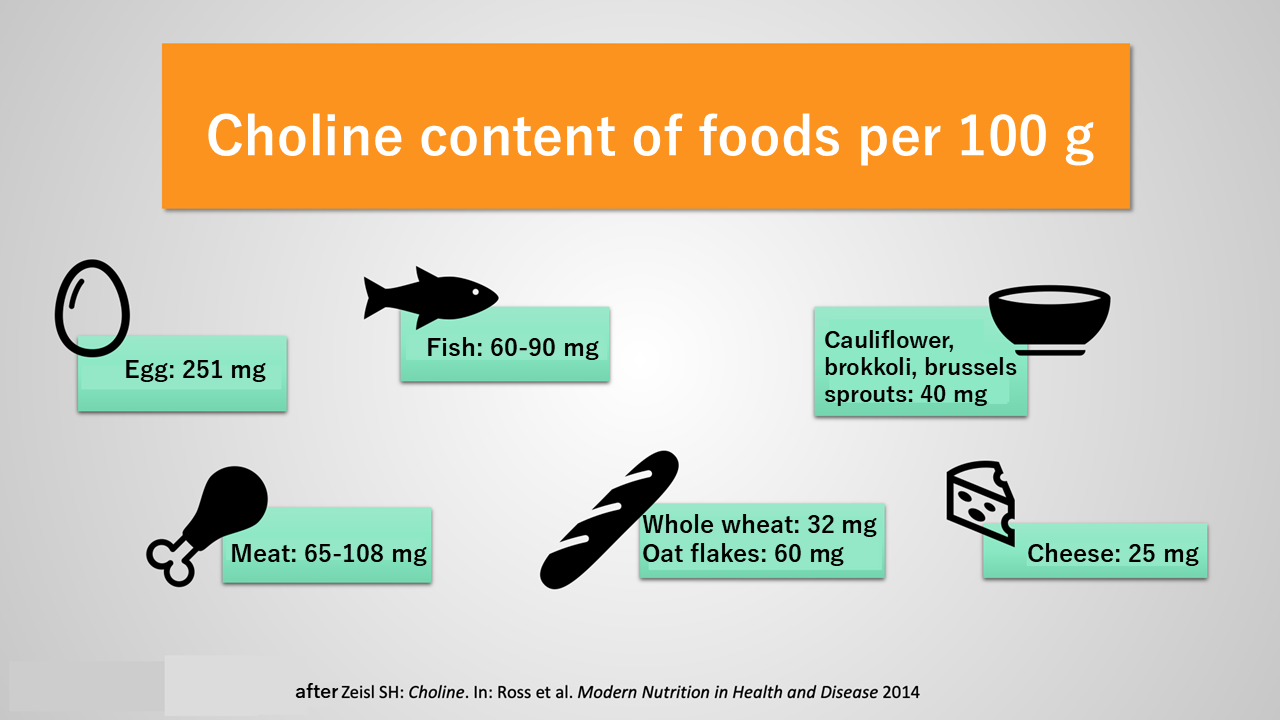
- Choline from food, that is, eggs, fish, liver, legumes, is uncritical from the TMAO standpoint.
- With normal kidney function, a slight elevation of TMAO is, by current understanding, rather not associated with health problems.
- With impaired kidney function, TMAO becomes a risk factor for cardiovascular events and mortality. That is the group where particular caution with high-dose choline supplements is warranted. For that reason, it is worth having a current creatinine value with eGFR measured before longer high-dose supplementation.
PEMT and choline requirement: why some women need considerably more choline
The body can produce phosphatidylcholine itself, namely via the enzyme PEMT (phosphatidylethanolamine-N-methyltransferase). How well this works differs genetically. A common gene variant, in technical terms a polymorphism, with the identifier rs12325817, sits in the regulatory region of the PEMT gene and markedly increases the choline requirement.
On a low-choline diet, 80 percent of the women who were homozygous carriers of the change in the PEMT gene developed signs of a choline deficiency in the form of liver or muscle dysfunction. In women with only one copy, that is, heterozygous changes, it was 43 percent. (Nutrients 2017)
On top of this comes a hormonal factor that is likely relevant for many readers. Estrogen induces PEMT, which means: postmenopausal women have a higher choline requirement than premenopausal ones, and rs12325817 amplifies this further.
This probably explains why some women respond markedly to choline intake and others not at all!
Note: anyone who has their raw data from one of the common genetic providers can look up rs12325817 there. For this group, choline through the diet, and if necessary as phosphatidylcholine, is considerably (!) more sensible than for the average person.
Choline and liver disease
What happens with too little choline is already in the figure above: liver and muscle dysfunction. Choline deficiency leads to fatty liver.
Practically even more interesting is a second PEMT variant, rs7946. In postmenopausal women with a GG constellation there, a choline intake above 448 mg daily was associated with a 79 percent lower risk of a fatty liver. Anyone carrying one or two copies of the A variant had the lower risk anyway, regardless of intake. In men with the same GG constellation, by contrast, a high choline intake went along with a 3.7-fold increased risk. That is, the same gene variant may have completely different effects depending on sex.
As a limitation, though, one must say that the numbers come from a study of older Taiwanese patients with metabolic diseases (Nutrients 2023).
Choline and citicoline for brain fog and dementia
The reasoning behind the use of choline in neurodegenerative diseases is an increase in acetylcholine levels achieved through it, since in Alzheimer's, for example, acetylcholinesterase inhibitors (that is, drugs that prevent the breakdown of acetylcholine) can help.
In favor of this thesis is that the use of acetylcholine-blocking drugs (so-called anticholinergics) is associated with a higher occurrence of dementia cases. Since older-generation antihistamines are often anticholinergic, a separate article was devoted to the matter years ago.
For citicoline, the evidence is by now more extensive, but it too contradicts itself. A meta-analysis from 2023 evaluated seven studies in mild cognitive impairment, Alzheimer's, and post-stroke dementia and found consistently positive effects on cognitive function, but points out that there is a large risk of bias.
Long COVID, dopamine, and citicoline: a trail that is only just emerging
While this article was being written, a paper appeared that is worth including here, even though at first glance it has nothing to do with choline.
A group at the Centre for Addiction and Mental Health in Toronto used PET imaging to investigate how the dopaminergic neurons are doing in long COVID. What was measured was the binding of VMAT2, an established marker for the density of dopamine-releasing neurons. In 24 affected individuals, this binding was significantly lower throughout the striatum than in 24 age-matched controls. The striatum is the region responsible for motivation, movement, learning, and cognition, and the symptoms involved are fatigue, brain fog, memory problems, and lack of drive. The group is already planning a clinical study specifically targeting the dopamine system.
Now, citicoline is not only a choline supplier. In an animal model in 1991, it increased dopamine release, inhibited the reuptake of dopamine, and in aging mice increased the density of dopamine receptors, and precisely in the striatum of all places.
Those would be two puzzle pieces that fit together. However, the dopamine data on citicoline come overwhelmingly from animal experiments and pharmacological review articles. The long COVID paper has 24 participants and must first be replicated; and a study on citicoline in long COVID does not exist. So this should explicitly not be understood as a recommendation, but rather as connecting, puzzling, and thinking out loud about a trail that is only just emerging.
Choline requirement and dose
For Europe, the EFSA set a reference value in 2016: 400 mg of choline per day for adults, 480 mg in pregnancy, and 520 mg during breastfeeding (EFSA 2016). Unlike the US recommendation, which distinguishes between 550 mg for men and 425 mg for women, this is a single value for everyone.
The DGE, by the way, has no reference value for choline at all; it does not yet list it as an essential nutrient. Vegans and vegetarians, as already with creatine, are more at risk of taking in too little choline than "omnivores."
Conclusion
Choline is convincing as a nutrient in the case of an actual increased requirement: PEMT variant, postmenopause, vegan or vegetarian diet. These are situations with an understandable requirement gap, and there an intake makes sense. Ideally through the diet, and if supplemented, then rather as phosphatidylcholine or perhaps citicoline. The developing picture around citicoline, dopamine, and other new connections is worth following closely, a reminder of how quickly the evidence in this area keeps shifting.