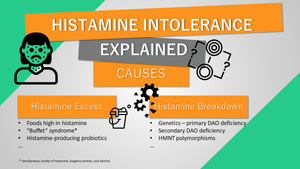
Histamine intolerance has become the common term in everyday use. Unlike lactose intolerance, where the enzyme lactase is missing to break down lactose, histamine intolerance is currently not understood as the result of one single missing enzyme. Guidelines therefore suggest the term histamine intolerance syndrome (HIS), also called histamine sensitivity. Here, all these terms are used interchangeably.
Histamine intolerance results from an imbalance between the production and breakdown of this messenger molecule. This imbalance can develop either from too much histamine intake (through food, for example) or from reduced breakdown due to genetic or acquired causes (see table 1).
| Cause: histamine excess | Cause: reduced histamine breakdown |
| Food poisoning (spoiled fish) | Secondary DAO deficiency (more common), caused by medication or gastrointestinal disease |
| "Buffet syndrome" (simultaneous intake of histamine, other biogenic amines, and alcohol) | Primary DAO deficiency (genetic) |
| Small intestinal bacterical overgrowth (SIBO) | HNMT polymorphisms (genetic variants that slow histamine breakdown) |
| Histamine producing probiotics | |
| Hormonal changes often affect individual histamine intolerance as well |
To understand the causes of histamine intolerance, it helps to take a closer look at how the body breaks histamine down.
How the body breaks down histamine
Breakdown differs depending on where the histamine is located
When too much histamine builds up, the body needs to be able to break it down again. There are two separate pathways, depending on whether the histamine is located outside a cell (extracellular) or inside one (intracellular).
Extracellular histamine is broken down mainly by the enzyme diamine oxidase (DAO). Since many foods contain more histamine than the body needs or can tolerate, DAO is found in especially high concentrations in the gut, where it breaks down excess histamine before it can even be absorbed.
Intracellular histamine is broken down by an enzyme called histamine N-methyltransferase (HNMT). [1]
The exact breakdown pathways are shown in figure 2. Disruptions in either pathway point to the underlying cause of an imbalance in the body's histamine handling.
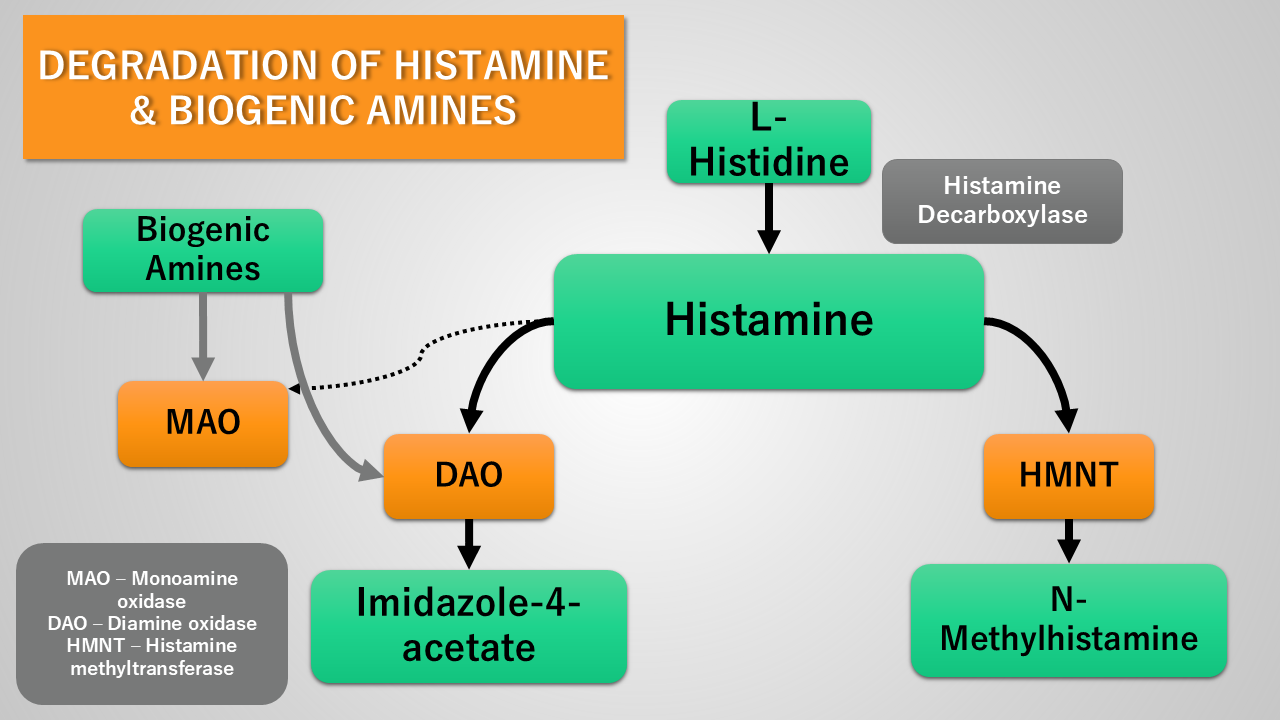
Biogenic amines other than histamine often contribute to the symptoms and complex picture of histamine intolerance as well, so they are included in the diagram, too. If you want to know more about biogenic amines specifically, you will find the answer in the article on biogenic amines.
Causes of histamine intolerance in detail
Histamine poisoning as a cause of histamine sensitivity
„Sola dosis facit venenum.“ (The dose makes the poison.) – Paracelsus
People with histamine intolerance react to very small amounts of histamine. Their tolerance threshold sits well below that of the average population. But large amounts of histamine cause problems even in healthy people. This becomes especially clear with food poisoning, particularly from spoiled fish, which can contain enormous amounts of histamine.
Overload from biogenic amines
Some researchers have coined the term "buffet syndrome." At a buffet, people consume a large amount of different foods and drinks, some containing substantial amounts of biogenic amines, histamine among them.
Consuming a variety of other biogenic amines alongside histamine can overload the pathways that break histamine down, since these additional amines compete with histamine for the same enzyme capacity. As a result, less histamine can be broken down in the same amount of time. Alcohol can amplify this effect further, since it inhibits DAO, the enzyme central to histamine breakdown. Even people who are otherwise not particularly sensitive to histamine can develop symptoms under these conditions. [2]
Small intestinal bacterial overgrowth (SIBO) as a cause of histamine excess
When bacteria that do not belong in the small intestine colonize it and produce histamine while breaking down food, this leads to symptoms as well. This is known as small intestinal bacterial overgrowth (SIBO). Affected patients often report bloating in particular.
If bloating keeps recurring shortly after eating, SIBO should be ruled out. [3] The good news is that SIBO is treatable, and treating it often significantly eases histamine intolerance symptoms too.
Histamine-producing probiotics
Certain probiotics, bacterial strains taken specifically to support digestion, can also produce histamine. Lactobacillus reuteri, normally a harmless gut bacterium valued for its anti-inflammatory properties, can increase the activity of histidine decarboxylase, the enzyme the body uses to produce histamine from its precursor, histidine. This means Lactobacillus reuteri indirectly increases histamine production. At the same time, this bacterial species also has anti-inflammatory properties that can be beneficial. [4]
According to one study, Lactobacillus casei (TISTR 389) and Lactobacillus delbrueckii subsp. bulgaricus (TISTR 895) can produce biogenic amines as well. These then compete with histamine for the DAO capacity available in the intestinal wall, meaning less histamine gets deactivated and more ends up being absorbed from the gut. However, the study's authors are clear that each strain needs to be tested individually, production (or lack of it) cannot be assumed across an entire species. [5]
Individual tolerance matters a great deal here. Probiotics should never be taken "just because," on the assumption that they cannot cause harm. In organic acid intolerance, it is even possible that no probiotics at all are well tolerated.
Acquired DAO deficiency as a cause of histamine intolerance
Diamine oxidase (DAO), the enzyme that breaks down extracellular histamine, is normally found in especially high concentrations in the gut. DAO is needed to break down dietary histamine already in the intestine, keeping absorption within a range the body can handle. Certain illnesses or medications, however, can lead to an acquired DAO deficiency (see How the body breaks down histamine). [1] Experts also refer to this as a secondary deficiency.
Medications blocking histamine breakdown
Various substances, including certain medications as well as some vitamins and alcohol, can block DAO. For some patients, simply adjusting their medication can significantly ease symptoms. [1]
Deficiency of cofactors needed by diamine oxidase (DAO)
To function fully, diamine oxidase depends on certain other substances, known as cofactors. Copper and vitamins B6 and C are particularly important here. A deficiency in these cofactors can reduce DAO activity and lead to higher histamine levels. [1]
One caveat: vitamin B6 is not just a cofactor for breaking histamine down. Histidine decarboxylase, the enzyme responsible for producing histamine, also needs vitamin B6 (also known as pyridoxine). [6]
So vitamin B6 intake supports both the breakdown and the production of histamine. Excessive supplementation with vitamin B6 can therefore do more harm than good. A blood test can help determine the right individual dosage.
Inflammatory bowel disease and secondary DAO deficiency
Inflammatory bowel diseases such as Crohn's disease, as well as gastrointestinal allergies, can also play a role in acquired, reduced DAO production in the gut. Gastrointestinal allergies in particular are often overlooked, since they do not come with the elevated IgE levels typically seen in blood tests for other allergies.
These allergic reactions in the gastrointestinal tract resemble local inflammatory responses in the intestinal lining, which then cannot produce as much DAO as the body actually needs. [7] [8] When an underlying gastrointestinal condition is present, treating it becomes essential.
Genetic causes of reduced histamine breakdown
Different variants of a gene, known in genetics as polymorphisms, occur naturally throughout the population and are only linked to disease in specific cases. Some gene variants can even offer an advantage under certain conditions. The classic example is the protection against malaria provided by the otherwise disadvantageous S-variant of hemoglobin, the red blood pigment responsible for sickle cell disease.
DAO mutations: a genetic cause of histamine intolerance?
Certain polymorphisms in the gene coding for diamine oxidase are associated with reduced activity of the DAO enzyme. This leads to a primary DAO deficiency, one that is not acquired (secondary) through medication, but rooted in genetic makeup. [1]
A study from Mexico, for example, found that mothers of children with allergies who also suffered from migraines had a significantly higher rate of the DAO C2029G mutation. [9]
HNMT polymorphisms: a genetic link to histamine intolerance?
As explained previously, DAO is not the only enzyme involved in histamine breakdown, HNMT plays a role too. Histamine N-methyltransferase breaks down intracellular histamine, which is why HNMT polymorphisms in particular seem to be linked more closely to central nervous system symptoms that occur independently of food intake.
If a genetic variant of HNMT with reduced activity is present, medications that release histamine (known as histamine liberators) and medications that further reduce HNMT activity should be avoided where possible.
HNMT mutations appear to occur more frequently in certain inflammatory skin conditions, such as atopic dermatitis, and in aspirin-induced urticaria (an intensely itchy, red rash with raised welts). [10] The "pseudoallergic" reactions to aspirin seen in Samter's triad and salicylate intolerance may also be associated with HNMT mutations.
In the migraine study cited previously, it was not just DAO mutations that were linked to greater migraine severity, the HNMT C314T mutation was too. [9]
A connection to changes in histamine metabolism and HNMT polymorphisms also appears to exist in Parkinson's disease. [11]
Closing thoughts and further reading
As this article shows, the causes of histamine intolerance are complex and varied. Further research is still needed to fully understand this complex condition. This can make treatment more challenging, but at the same time, narrowing down the individual causes opens the door to a more targeted treatment approach for histamine intolerance.
References
[1] Maintz L, Novak N. Histamine and histamine intolerance. Am J Clin Nutr. 2007;85(5):1185-1196. doi:10.1093/ajcn/85.5.1185
[2] Wüthrich B. Kopfweh, Niesattacken und Co. durch biogene Amine. [Headaches, sneezing fits and more caused by biogenic amines]. Dermatologie - Praxis. 2011;(Heft 2):4-8.
[3] Pimentel M, Constantino T, Kong Y, Bajwa M, Rezaei A, Park S. A 14-Day Elemental Diet Is Highly Effective in Normalizing the Lactulose Breath Test. Dig Dis Sci. 2004;49(1):73-77. doi:10.1023/B:DDAS.0000011605.43979.e1
[4] Thomas CM, Hong T, Pijkeren JP van, et al. Histamine Derived from Probiotic Lactobacillus reuteri Suppresses TNF via Modulation of PKA and ERK Signaling. PLOS ONE. 2012;7(2):e31951. doi:10.1371/journal.pone.0031951
[5] Deepika Priyadarshani WM, Rakshit SK. Screening selected strains of probiotic lactic acid bacteria for their ability to produce biogenic amines (histamine and tyramine): Screening selected strains of probiotic lactic acid bacteria. Int J Food Sci Technol. 2011;46(10):2062-2069. doi:10.1111/j.1365-2621.2011.02717.x
[6] Snell EE. Vitamin B6 and decarboxylation of histidine. Ann N Y Acad Sci. 1990;585:1-12. doi:10.1111/j.1749-6632.1990.tb28037.x
[7] Petersen J, Raithel M, Schwelberger HG. Histamine N-methyltransferase and diamine oxidase gene polymorphisms in patients with inflammatory and neoplastic intestinal diseases. Inflamm Res Off J Eur Histamine Res Soc Al. 2002;51 Suppl 1:S91-92. doi:10.1007/pl00022464
[8] Kuefner MA, Schwelberger HG, Weidenhiller M, Hahn EG, Raithel M. Both catabolic pathways of histamine via histamine-N-methyltransferase and diamine oxidase are diminished in the colonic mucosa of patients with food allergy. Inflamm Res Off J Eur Histamine Res Soc Al. 2004;53 Suppl 1:S31-32. doi:10.1007/s00011-003-0314-5
[9] Meza-Velázquez R, López-Márquez F, Espinosa-Padilla S, Rivera-Guillen M, Ávila-Hernández J, Rosales-González M. Association of diamine oxidase and histamine N-methyltransferase polymorphisms with presence of migraine in a group of Mexican mothers of children with allergies. Neurol Barc Spain. 2017;32(8):500-507. doi:10.1016/j.nrl.2016.02.025
[10] Kim S-H, Kang Y-M, Cho B-Y, Ye Y-M, Hur G, Park H-S. Histamine N-methyltransferase 939A>G polymorphism affects mRNA stability in patients with acetylsalicylic acid-intolerant chronic urticaria. Allergy. 2009;64:213-221. doi:10.1111/j.1398-9995.2008.01795.x
[11] Agúndez JAG, Luengo A, Herráez O, et al. Nonsynonymous polymorphisms of histamine-metabolising enzymes in patients with Parkinson’s disease. Neuromolecular Med. 2008;10(1):10-16. doi:10.1007/s12017-007-8017-7