Some people with histamine intolerance also react to other biogenic amines. This often shows up in a specific pattern: a low-histamine diet improves symptoms, but allergy-like symptoms similar to histamine intolerance keep showing up despite careful dietary adjustments. If no allergies or other intolerances are present, other biogenic amines may be the trigger.
Biogenic amine intolerance means a sensitivity to amines beyond histamine, such as tyramine, putrescine, and also spermine and spermidine. When these are present in food in larger amounts, they can trigger symptoms similar to histamine intolerance, or make existing symptoms worse [1, 2].
What are biogenic amines?
Biogenic amines are a group of substances that form when amino acids are broken down or converted. Histamine is the most relevant one when it comes to intolerance, but it is far from the only one. Many hormones and nervous system messengers, including serotonin (a key messenger in the brain), also belong to this group [3].
We need biogenic amines to survive. Unlike vitamins, the body can produce them itself from amino acids. Even though research into them is still incomplete, it's clear they serve important functions. Spermidine, another biogenic amine, is currently being studied for possible benefits in certain forms of dementia [4].
Is biogenic amine intolerance an independent condition?
In most cases, biogenic amine intolerance develops as part of histamine intolerance rather than on its own. That said, some people appear to be noticeably more sensitive to specific amines than others. Some migraine patients, for example, show increased sensitivity to the biogenic amine tyramine [2].
Strictly speaking, the term "general biogenic amine intolerance" is a bit misleading. In most cases, it is an excess of histamine that actually causes the symptoms. The other biogenic amines are not the direct cause, they compete with histamine for the same breakdown capacity. This drives histamine levels up, and that is what triggers the symptoms. This is why biogenic amine intolerance symptoms largely mirror those of histamine intolerance.
Symptoms of biogenic amine intolerance
Symptoms closely resemble histamine intolerance
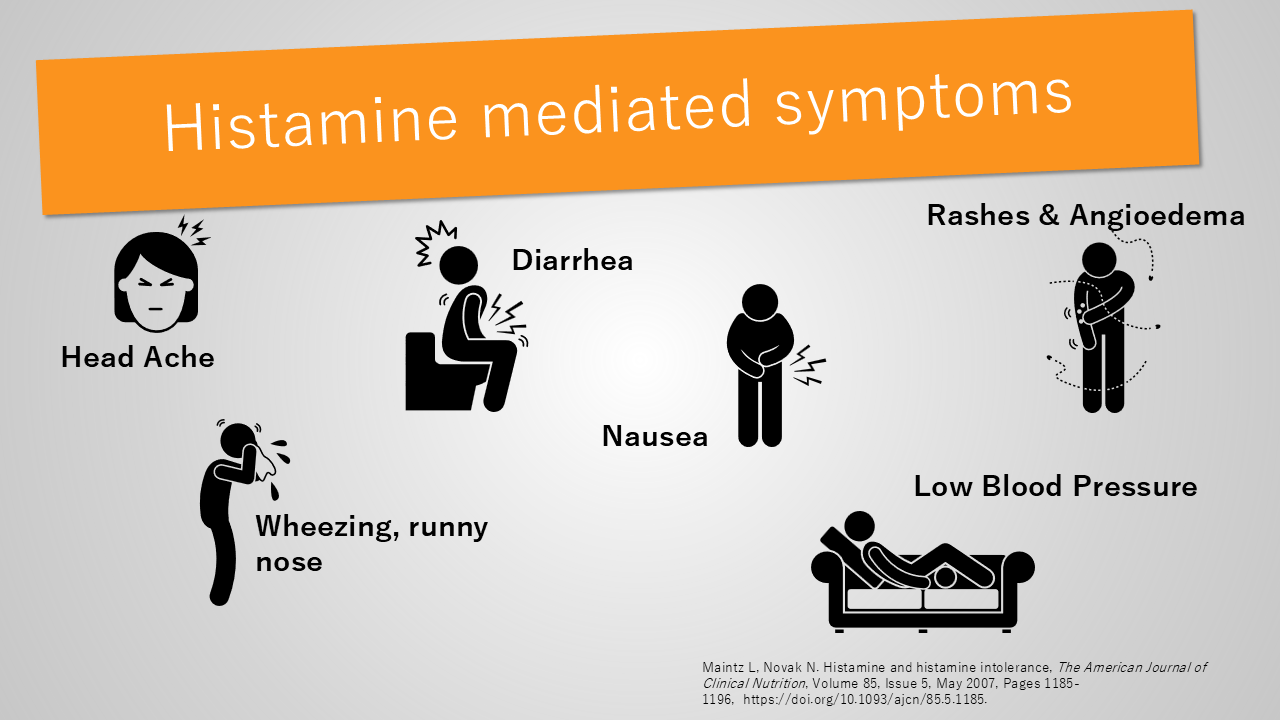
Symptoms of biogenic amine sensitivity generally match what you would see with excess histamine from any cause. Since histamine acts on many different sites in the body, the symptoms are wide ranging but ultimately very similar to histamine intolerance:
- Headaches
- Abdominal pain, diarrhea, bloating
- Runny nose, sneezing, itchy or burning eyes
- Itchy rash
- Breathing difficulties (asthma), heart palpitations
- Period pain, flushing (skin redness)
- Low blood pressure
These can all result from excess histamine. As explained earlier, biogenic amine intolerance usually occurs alongside histamine intolerance rather than in isolation. können durch ein Zuviel an Histamin auftreten. [2,5]
Why can biogenic amines be problematic in histamine intolerance?
Biogenic amines, like histamine, need to be broken down
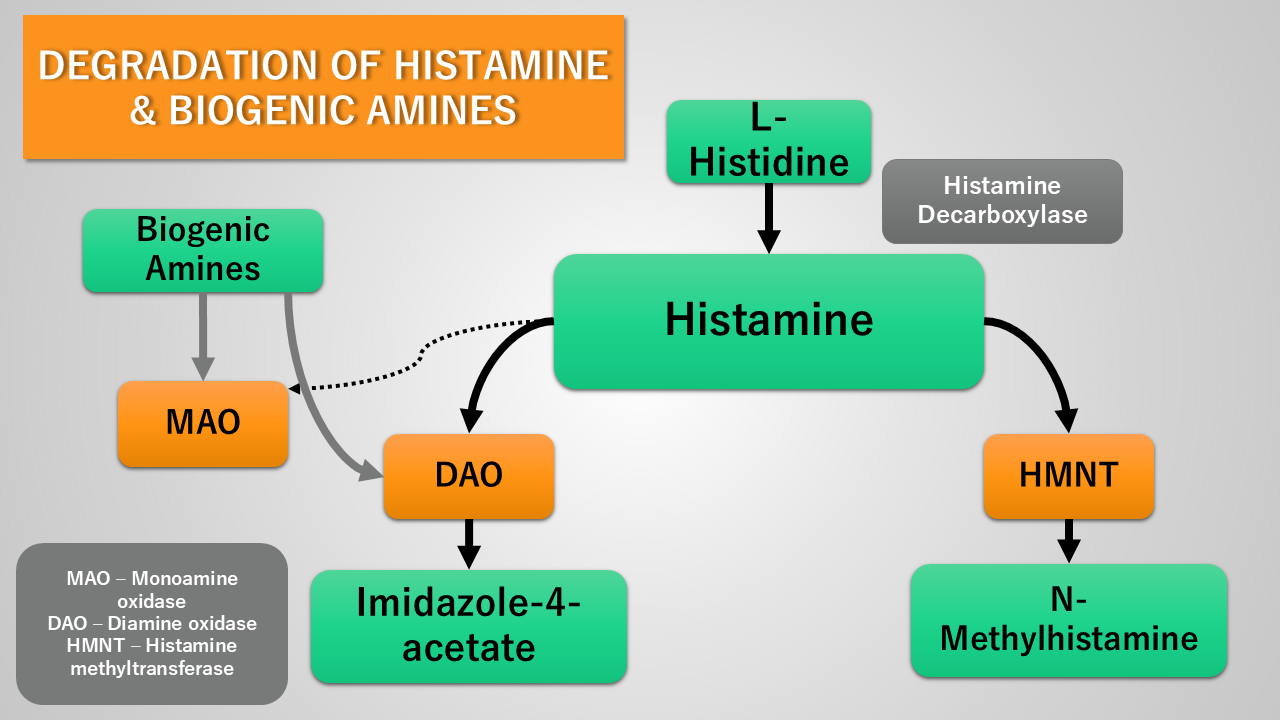
Biogenic amines are broken down mainly through two enzymes: monoamine oxidase (MAO) and diamine oxidase (DAO). Since many biogenic amines share the same metabolic pathways, the available amount of a given enzyme is often the limiting factor for how quickly this breakdown can happen [5]. (The article Root causes of histamine intolerance discusses various pathways of histamine degradation in detail)
When the capacity of the enzyme diamine oxidase (DAO) gets used up breaking down other biogenic amines, less of it remains available for histamine. The result is a worsening of the histamine intolerance symptoms described previously [5].
MAO inhibitors and histamine or biogenic amine sensitivity
Changes or impairments in biogenic amine breakdown affect people with histamine intolerance more strongly when medications interfere with these processes. A good example is MAO inhibitors, drugs that block the action of monoamine oxidase.
These are widely used for their antidepressant effects, and inhibiting MAO in the brain is the intended effect there, since it slows the breakdown of the biogenic amine serotonin. But because this inhibition affects the whole body and not just the brain, the primary breakdown pathway for biogenic amines gets blocked throughout, shifting the workload onto the alternative pathway via DAO.
These amines then compete with histamine for the available DAO. Less DAO is left over for histamine breakdown, so histamine levels rise, which can trigger or worsen histamine intolerance symptoms in sensitive individuals. [5]
People with histamine intolerance tend to tolerate MAO inhibitors poorly, and these medications can cause new or worsening symptoms. [5]
Where are biogenic amines found?
Histamine is especially common in aged foods. Many histamine-rich foods are also high in tyramine: aged cheeses in particular, red wine, bananas, and even raspberries (which you might not expect to be histamine-rich) contain significant amounts of tyramine.
Other biogenic amines like spermine and spermidine are found mainly in cashews, pears, wheat germ, and legumes. Cadaverine is produced by gut bacteria when they break down the amino acid lysine. Putrescine forms from the breakdown of the amino acid ornithine. Both are found mainly in wheat germ. [6,7]
Biogenic amine intolerance results from a disruption of the body's finely tuned histamine balance
As explained in the article on histamine intolerance, histamine naturally occurs in the body, and a certain amount is not just normal but essential. Under normal conditions, the body's biochemical processes keep this amount in balance through production and breakdown.
It comes down to a delicate balance between intake or production and breakdown of histamine. Overloading the breakdown pathways with a high intake of biogenic amines pushes histamine levels up, with the consequences described previously.
This is why foods that contain little or no histamine, but larger amounts of other biogenic amines, can still cause problems. Tyramine plays a particularly notable role here, especially for migraine patients, who can be especially sensitive to this biogenic amine.
Tyramine sensitivity and the migraine hypothesis
People with migraines often instinctively know what agrees with them, and whether foods like cheese, red wine, raspberries, avocados, or bananas tend to trigger or worsen their migraines. What these foods have in common is that they're rich in one particular biogenic amine: tyramine.
The tyramine hypothesis for migraine headaches is a fairly old one, first developed in the 1960s. Placebo-controlled studies looking at the link between migraine and tyramine have not always shown a clear connection, but they also have not reliably disproven it either. Because of this, the scientific consensus is that the migraine-tyramine hypothesis carries at least some validity.[2]
Managing biogenic amine intolerance
An elimination diet is the best test, and a treatment approach at the same time
An elimination diet involves consistently avoiding histamine-rich foods, as well as foods very high in other biogenic amines, for around 14 days. If this leads to a clear improvement in symptoms, it points to an intolerance to histamine and possibly other biogenic amines as well.
The next step is to gradually reintroduce foods, starting with foods containing other biogenic amines while continuing to avoid histamine itself. If symptoms return at this stage, that suggests an intolerance to other biogenic amines is also present.
After that, you can carefully test your individual tolerance threshold for biogenic amines, and for histamine in particular. A food and symptom diary can be very useful here. [1,5]
References
[1] Reese I, Ballmer-Weber B, Beyer K, Dölle-Bierke S, Kleine-Tebbe J, Klimek L, Lämmel S, Lepp U, Saloga J, Schäfer C, Szepfalusi Z, Treudler R, Werfel T, Zuberbier T, Worm M. Guideline on management of suspected adverse reactions to ingested histamine: Guideline of the German Society for Allergology and Clinical Immunology (DGAKI), the Society for Pediatric Allergology and Environmental Medicine (GPA), the Medical Association of German Allergologists (AeDA) as well as the Swiss Society for Allergology and Immunology (SGAI) and the Austrian Society for Allergology and Immunology (ÖGAI). Allergol Select. 2021 Oct 5;5:305-314. doi:10.5414/ALX02269E
[2] Kohlenberg, R.J. (1982), Tyramine Sensitivity in Dietary Migraine: A Critical Review. Headache: The Journal of Head and Face Pain, 22: 30-34. doi:10.1111/j.1526-4610.1982.hed2201030.x
[3] DocCheck Medical Services. Biogenes Amin. DocCheck Flexikon. Accessed July 15, 2026. https://flexikon.doccheck.com/de/Biogenes_Amin
[4] Schwarz C, Stekovic S, Wirth M, et al. Safety and tolerability of spermidine supplementation in mice and older adults with subjective cognitive decline. Aging (Albany NY). 2018;10(1):19-33. doi:10.18632/aging.101354
[5] Maintz L, Novak N. Histamine and histamine intolerance. Am J Clin Nutr. 2007;85(5):1185-1196. doi:10.1093/ajcn/85.5.1185
[6] Karovičová J, Kohajdová Z. Biogenic amines in food. Chem Pap. 2005;59(1):70-79. doi:10.1002/chin.200534338
[7] Nishibori, Naoyoshi & Yamamoto, Akihiro & Akatuki, Toshiko. (2007). Amounts of polyamines in foods in Japan and intake by Japanese. Food Chemistry - FOOD CHEM. 100. 491-497. doi:10.1016/j.foodchem.2005.09.070