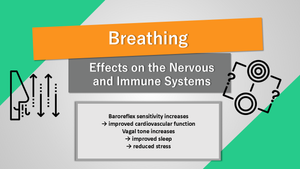
The idea that breathing influences our state of consciousness has been used by many cultures throughout history in various meditation practices. For a long time, though, the processes these techniques trigger in the body could not be properly studied, simply because the technology to measure them did not exist yet.
Coherent breathing and slow-paced breathing
Slow breathing techniques bring the breathing rate down to 10 breaths per minute or fewer. Coherent breathing goes even further, with just six breaths per minute, meaning each full breath cycle lasts around 10 seconds.
Both techniques affect heart rate variability (HRV), a marker of how much physical and psychological strain a person is under. This works because the involuntary, or autonomic, nervous system directly influences heart rate.
What slow breathing techniques exist?
- Pranayama breathing: 2 to 5 breaths per minute
- Zen breathing (tanden breathing): 3 to 4 breaths per minute
- Coherent breathing / HRV biofeedback breathing: 6 breaths per minute
- Slow-paced breathing: up to 10 breaths per minute
Coherent and slow breathing influence the autonomic nervous system
Heart rate variability can be broken down into three frequency bands: high frequency (HF), low frequency (LF), and very low frequency (VLF). The HF band is often used as a marker of parasympathetic nervous system activity, though the exact meaning and function of the different frequency bands is not yet fully understood. [1]
The parasympathetic nervous system is often described, simply put, as the "rest and digest" branch of the nervous system, since it supports processes like digestion and recovery. Slow breathing techniques appear to stimulate the parasympathetic nervous system, which shows up, for example, as increased HRV. [2]
The vagus nerve, the longest cranial nerve, is part of the parasympathetic nervous system, which is why the term "vagal tone" often comes up in discussions of parasympathetic activity.
Slow breathing increases feelings of relaxation
Slow breathing techniques appear to have a calming effect and reduce states of heightened arousal. Study participants often reported less anxiety, along with more positive energy and relaxation after breathing exercises, though some studies found no significant emotional changes. [2]
Slow breathing also seems to help the body cope with stress.
Certain breathing techniques appear to buffer against stress
One small study found that when stress was induced through reduced oxygen intake, participants instructed to breathe slowly showed no stress-related changes in heart rate. [3]
Slow breathing also increases baroreflex sensitivity, which has a positive effect on the body. Baroreceptors, located in the large arteries, measure blood pressure and relay this information to the brainstem, which then regulates heart rate and vascular resistance accordingly. The more sensitive this reflex, the better the cardiovascular system can stay balanced. [4]
Baroreflex sensitivity (BRS) is reduced in patients with heart failure and in conditions affecting the autonomic nervous system (neuropathies). It can also be altered in post-traumatic stress disorder and other conditions. [3] [4]
Breathing may even affect the brain and our emotions
Our breathing rhythm is controlled by a breathing "pacemaker" in the brainstem. In an experiment at Stanford University School of Medicine, researchers found that specific neurons in the brain's breathing center are responsible for communication between breathing rhythm and emotional state, and can actually shift how stress is experienced.
Researchers Krasnow and Yackle genetically modified mice so they could no longer sigh. Initially disappointed that nothing else about the animals' breathing had changed, they noticed the mice were noticeably less stressed and behaved differently. The mice reacted much more calmly to unfamiliar environments and appeared far less sensitive to stress overall. This clearly demonstrated that these brainstem neurons do not just control breathing, they also influence behavior, and likely emotions as well. [5]
Evening breathing exercises support better sleep
In a study involving 64 healthy participants, researchers compared the effects of 30 days of 15-minute coherent breathing sessions against 15 minutes of social media use (Facebook, WhatsApp, Instagram, and similar platforms) on subjective sleep quality and cardiac vagal activity (CVA), a specific high-frequency measure of heart rate variability. [5]
Participants practicing coherent breathing not only reported better sleep subjectively, they also showed increased parasympathetic activity, or vagal tone, measured overnight. This effect was still detectable the following morning.
Whether higher CVA is itself an indicator of better sleep quality isn't fully settled yet. There is evidence, though, that lower CVA tends to occur more often in people with sleep disorders and those with chronic fatigue syndrome/ME. [5] [6]
Breathing exercises influence the immune system
A 2021 paper proposed slow breathing as a preventive strategy for elite athletes experiencing pandemic-related stress.
Since slow breathing has the potential to improve sleep, and adequate sleep is essential for a well-functioning immune system, the researchers hypothesized that breathing training could have a positive effect on immune defense through this pathway alone.
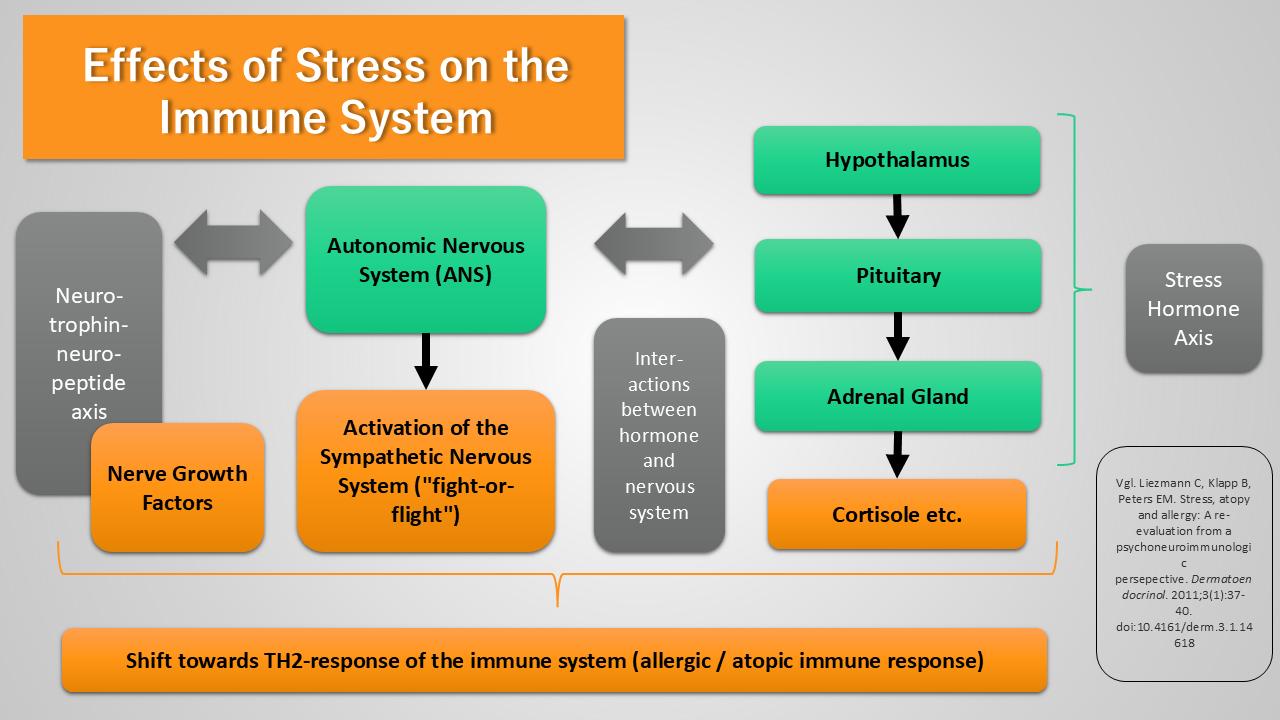
Under significant stress, sleep deprivation, for example, the immune response tends to shift toward a Th2-dominant pattern. A Th2-skewed immune response tends to make the immune system more prone to developing allergies or reacting in an allergic way more generally. [7]
A reduced Th1 response also means the body is less equipped to fight off infections that specifically require this type of immune response. The connection between the nervous system and the immune system is explored further in the article on hypnotherapy for allergies.
Breathing less can actually be more efficient and improve oxygenation
Slower breathing also has the potential to improve endurance and physical performance, since it increases breathing efficiency. [8]
Breathing efficiency means achieving higher oxygen saturation with fewer breaths. In patients with heart failure, training slower breathing not only subjectively improved shortness of breath, it also improved actual oxygen saturation. [9]
This nicely illustrates that fast, forceful breathing tends to be counterproductive, even though it might seem intuitive that more breaths would mean better oxygen supply.
Buteyko breathing therapy, used for example in patients with respiratory conditions like bronchial asthma, has long made use of these benefits of slower breathing.
Conclusion
Slow breathing techniques, such as coherent breathing, are simple to learn, cost nothing, and can have a genuinely positive effect on both the nervous and immune systems. Given how far-reaching these effects can be throughout the body, this is a technique worth recommending to nearly every patient in clinical practice.
References
[1] Heathers JAJ. Everything Hertz: methodological issues in short-term frequency-domain HRV. Frontiers in Physiology. 2014;5:177. doi:10.3389/fphys.2014.00177
[2] Zaccaro A, Piarulli A, Laurino M, et al. How Breath-Control Can Change Your Life: A Systematic Review on Psycho-Physiological Correlates of Slow Breathing. Front Hum Neurosci. 2018;12:353. doi:10.3389/fnhum.2018.00353
[3] Critchley HD, Nicotra A, Chiesa PA, et al. Slow breathing and hypoxic challenge: cardiorespiratory consequences and their central neural substrates. PLoS One. 2015;10(5):e0127082. doi:10.1371/journal.pone.0127082
[4] Schulz A. Baroreflex-Sensitivität im Dorsch Lexikon der Psychologie. Published online 2019. Accessed July 21, 2026. https://dorsch.hogrefe.com/stichwort/baroreflex-sensitivitaet
[5] Laborde S, Hosang T, Mosley E, Dosseville F. Influence of a 30-Day Slow-Paced Breathing Intervention Compared to Social Media Use on Subjective Sleep Quality and Cardiac Vagal Activity. J Clin Med. 2019;8(2):193. doi:10.3390/jcm8020193
[6] Burton AR, Rahman K, Kadota Y, Lloyd A, Vollmer-Conna U. Reduced heart rate variability predicts poor sleep quality in a case-control study of chronic fatigue syndrome. Exp Brain Res. 2010;204(1):71-78. doi:10.1007/s00221-010-2296-1
[7] Irwin MR. Why sleep is important for health: a psychoneuroimmunology perspective. Annu Rev Psychol. 2015;66:143-172. doi:10.1146/annurev-psych-010213-115205
[8] Borges U, Lobinger B, Javelle F, Watson M, Mosley E, Laborde S. Using Slow-Paced Breathing to Foster Endurance, Well-Being, and Sleep Quality in Athletes During the COVID-19 Pandemic. Front Psychol. 2021;12:624655. doi:10.3389/fpsyg.2021.624655
[9] Bernardi L, Spadacini G, Bellwon J, Hajric R, Roskamm H, Frey AW. Effect of breathing rate on oxygen saturation and exercise performance in chronic heart failure. The Lancet. 1998;351(9112):1308-1311. doi:10.1016/S0140-6736(97)10341-5