The role of cofactors in DAO production is poorly understood
Histamine intolerance comes with a wide range of symptoms, and many patients experience a significant burden. Because of this, more and more supplement manufacturers market formulations specifically for histamine intolerance that contain B6 or copper. The idea is that these nutrients support diamine oxidase levels or activity.
Diamine oxidase (DAO) is an enzyme, found mainly in the gut, responsible for breaking down dietary histamine. Optimizing DAO levels is meant to improve histamine intolerance symptoms. But what role does vitamin B6 actually play in DAO activity, and what's its connection to taurine synthesis?
Vitamin B6: a DAO cofactor?
Vitamin B6 is an umbrella term for several related vitamin compounds, including pyridoxal, pyridoxine, and pyridoxamine, and it is essential for many processes in the body. It is also the only vitamin where both a deficiency and an excess can cause polyneuropathy (tingling in the hands and feet, among other symptoms). For this reason, taking it, particularly at high doses, without first getting bloodwork to check B6 levels is strongly discouraged. [1]
B6 is often marketed as a cofactor for diamine oxidase (DAO) production on supplement manufacturer websites. However, there is very little in vivo research on this effect in humans. Most of the available research on vitamin B6, or its active form, pyridoxal-5-phosphate (PLP), and its role in DAO activity and production comes from animal studies or in vitro work done outside the human body, in petri dishes or test tubes. [2] [3] [4]
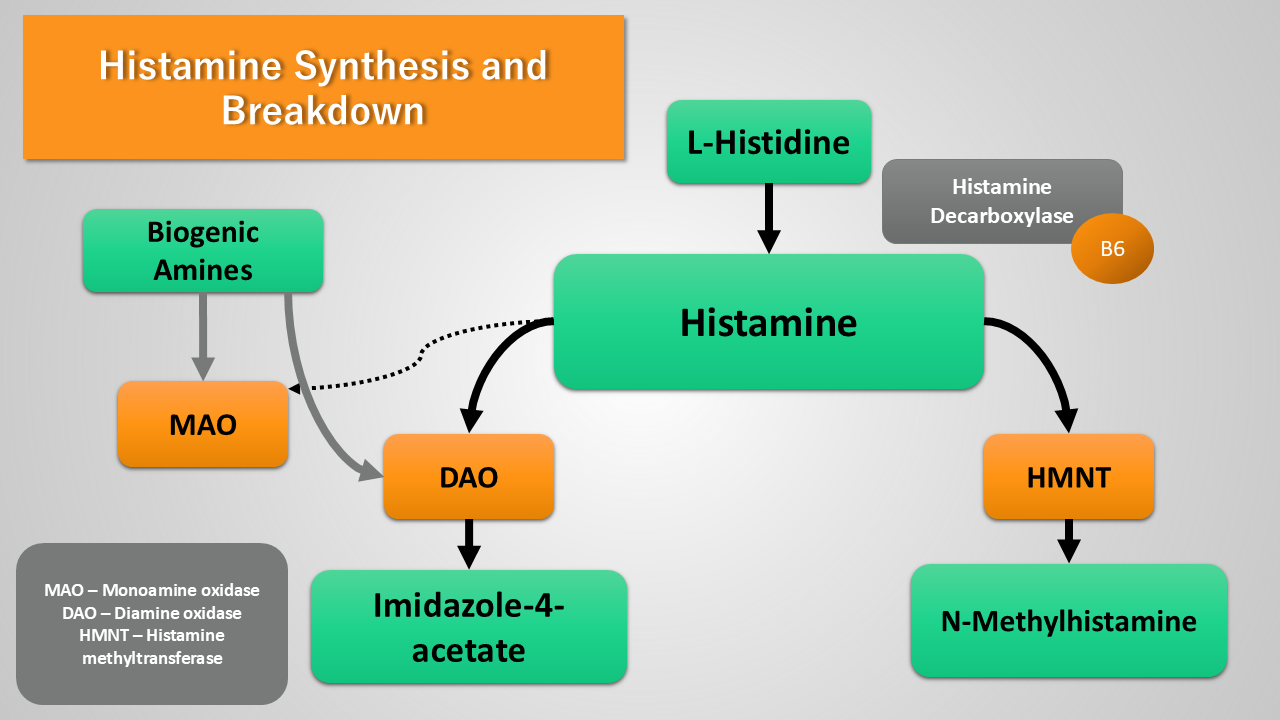
Vitamin B6 is involved in a wide range of processes in the body, including histidine decarboxylase, the enzyme that converts the amino acid histidine into histamine (covered in more detail in the article on the causes of histamine intolerance).
A connection between vitamin B6 and taurine
Quite a few histamine intolerance patients notice a positive effect from taking B6, though there may be explanations for this beyond the commonly repeated "B6 boosts DAO" theory found in many blogs. Correcting a vitamin B6 deficiency affects a wide range of metabolic processes, including taurine synthesis.
B6 is essential for taurine production, and taurine is an amino acid also associated with anti-inflammatory and anti-allergic properties. [5] [6] [7] Without adequate levels of the active form of B6, pyridoxal-5-phosphate, the metabolic pathways that lead to taurine production only function in a limited capacity.
If you would rather skip the metabolic details, feel free to jump ahead to taurine's anti-allergic properties below. Here is the underlying process, explained as simply as possible.
How the body produces taurine
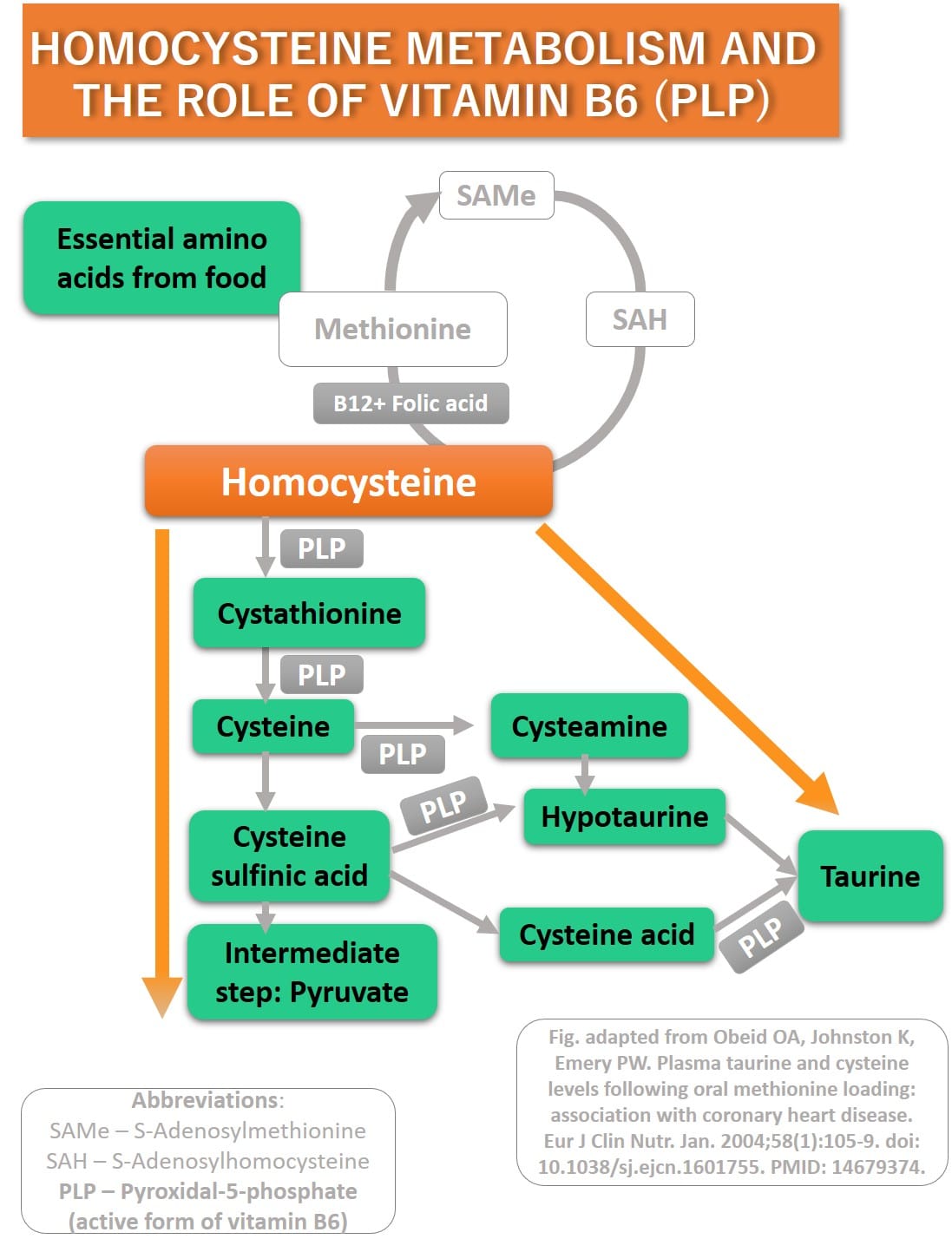
Pyroxydal-5-Phophat, aPyridoxal-5-phosphate, the active form of vitamin B6, is needed by the body to break down homocysteine, a metabolic byproduct, through a pathway known as transsulfuration.
Homocysteine forms as an intermediate product when certain amino acids, including the essential amino acids methionine and cysteine, are built up or broken down. These amino acids have to come from dietary protein, since the body cannot produce them itself, and they are essential building blocks for the body's own proteins.
Using the active form of vitamin B6, homocysteine is broken down through an intermediate step into the amino acid cysteine. Cysteine, in turn, serves as the starting material for producing pyruvate, sulfate, and taurine. Breaking cysteine down into taurine also requires B6. [8]
Taurine: common in energy drinks and complementary medicine
Taurine is an amino acid popular not just in complementary medicine circles and energy drinks (where it supposedly "gives you wings"), but also a genuine subject of medical research.
There are several biological pathways through which taurine might have a positive effect on the body, cardiovascular conditions, for example. [6] That said, it is worth noting again that several of the benefits attributed to taurine have not yet been confirmed in human studies or clinical trials.
Research on taurine, allergic symptoms, and histamine
There is research, mostly in animal models or in vitro, showing that taurine can help suppress inflammatory processes in the body. This anti-inflammatory effect works by influencing certain factors that, simply put, regulate whether specific genes get switched on. Taurine appears to influence the NF-κB transcription factor family (nuclear factor kappa light chain enhancer of activated B cells). NF-κB plays a role in regulating immune responses and the development of inflammatory processes. [6] [7]
In model studies, taurine intake reduced pro-inflammatory mediators. [6] [7] In a rat model of egg white allergy, both histamine and immunoglobulin E (IgE), markers of allergic inflammation, were significantly reduced after taurine administration. [5]
IgE plays a role in mediating allergic reactions and may be a familiar term even outside clinical circles, since doctors often test IgE levels in blood work when an allergy is suspected.
In the egg white allergy study mentioned above, the rats showed changes not just in lab values but also in behavior after taurine administration. They rubbed their noses less frequently, suggesting a likely reduction in allergic symptoms. Based on this, the researchers concluded that taurine might be helpful in allergic conditions. [5]
Given the lack of solid human studies on B6 and taurine in histamine-mediated and allergic conditions, it is only possible to speculate about how a vitamin B6 deficiency and/or taurine levels might affect allergic symptoms and histamine levels in people. Biochemically, B6 could plausibly influence histamine-mediated intolerances through the mechanisms described above, though it is worth emphasizing again that solid human studies on this are still missing.
Nutrient deficiencies in people with intolerances and gastrointestinal conditions
Many people with gastrointestinal conditions and intolerances, including histamine intolerance syndrome, end up with vitamin, trace element, and calorie deficiencies, both because of reduced food intake and a restricted diet, and because of generally poorer nutrient absorption.
Poorer absorption can result from underlying conditions like chronic inflammatory bowel disease or gastrointestinal allergies, both of which can also occur alongside histamine intolerance. Vitamin and nutrient deficiencies can have wide-ranging effects and can make things even more difficult for people dealing with multiple intolerances or mast cell issues.
If you are dealing with histamine intolerance, it is worth working with an experienced practitioner to identify the underlying cause, since this often opens the door to more tailored, effective treatment options. Did the histamine intolerance start alongside a new medication that might affect histamine metabolism? Are allergies present? It is important not to start high-dose vitamins or supplements based on suspicion alone, without medical or clinical guidance, and ideally with regular bloodwork to monitor levels while taking them.
These are just some of the factors that can contribute to the development of histamine intolerance. A more detailed breakdown of currently known mechanisms behind histamine intolerance and biogenic amine intolerance is available elsewhere on this site.
References
[1] Vrolijk MF, Opperhuizen A, Jansen EHJM, Hageman GJ, Bast A, Haenen GRMM. The vitamin B6 paradox: Supplementation with high concentrations of pyridoxine leads to decreased vitamin B6 function. Toxicol In Vitro. 2017;44:206-212. doi:10.1016/j.tiv.2017.07.009
[2] Saslak K, Kierska D, Maśliński Cz. Phosphopyridoxal complexes with histamine and histidine (5) the kinetics of cyclic compound formation between histamine and pyridoxal-5′-phosphate in the presence of pig kidney diamine oxidase and rat intestinal histaminase. Agents and Actions. 1977;7(1):19-25. doi:10.1007/BF01964876
[3] Martner-Hewes PM, Hunt IF, Murphy NJ, Swendseid ME, Settlage RH. Vitamin B-6 nutriture and plasma diamine oxidase activity in pregnant Hispanic teenagers. Am J Clin Nutr. 1986;44(6):907-913. doi:10.1093/ajcn/44.6.907
[4] Neree AT, Soret R, Marcocci L, Pietrangeli P, Pilon N, Mateescu MA. Vegetal diamine oxidase alleviates histamine-induced contraction of colonic muscles. Scientific Reports. 2020;10(1):21563. doi:10.1038/s41598-020-78134-3
[5] Nam S-Y, Kim H-M, Jeong H-J. The potential protective role of taurine against experimental allergic inflammation. Life Sci. 2017;184:18-24. doi:10.1016/j.lfs.2017.07.007
[6] Qaradakhi T, Gadanec LK, McSweeney KR, Abraham JR, Apostolopoulos V, Zulli A. The Anti-Inflammatory Effect of Taurine on Cardiovascular Disease. Nutrients. 2020;12(9):2847. doi:10.3390/nu12092847
[7] Ripps H, Shen W. Review: Taurine: A “very essential” amino acid. Mol Vis. 2012;18:2673-2686. Accessed February 17, 2019. https://www.ncbi.nlm.nih.gov/pmc/articles/PMC3501277/
[8] Obeid OA, Johnston K, Emery PW. Plasma taurine and cysteine levels following an oral methionine load: relationship with coronary heart disease. European Journal of Clinical Nutrition. 2004;58(1):105-109. doi:10.1038/sj.ejcn.1601755