New findings on B6 toxicity
Vitamin B6 is commonly recommended for neurological conditions, ME/CFS, and mast cell conditions, partly because it's thought to be "good for the nerves," and partly because it's believed to support histamine breakdown. A separate article covers B6's role in histamine metabolism in more depth.
What does not get nearly enough attention, though, is the toxic potential of B6 when taken in excess. Unlike most B vitamins, B6 is not harmless in excess, it is actually, ironically, neurotoxic. This applies in particular to pyridoxine HCl, the inactive synthetic form used in most supplements.
This means that recommending high-dose B6 without prior blood testing, particularly in a vulnerable group like people with multisystem conditions, who are often already dealing with neurological symptoms, carries real risk.
A case from clinical practice, and a sample product breakdown
This pattern has come up repeatedly enough in clinical practice to be worth flagging directly. One recent case involved a patient taking 25 mg of B6 daily. The dose had originally been prescribed by a doctor to correct a deficiency, but was never reevaluated or rechecked afterward. This led to measurably toxic B6 blood levels, even though the supplement had already been stopped nearly a week before testing. Measured levels were above 100 µg/L (normal reference ranges for pyridoxal-5'-phosphate go up to around 30 µg/L, depending on the lab).
To illustrate the dosing problem more concretely, it is worth breaking down a product commonly used within the mast cell community: Pure Encapsulations' "B-Complex Plus" contains 10 mg of B6 as pyridoxine HCl, plus an additional 10 mg of the active form, pyridoxal-5'-phosphate (P5P, or PLP).
What does that actually mean?
- Germany's national nutrition society (DGE) recommends 1.4 to 1.6 mg daily
- This product contains seven times the daily recommended dose of pyridoxine HCl (the problematic form)
- The total dose of 20 mg sits just under the EFSA upper limit of 25 mg
- Taken daily over months, this can become genuinely concerning, particularly for sensitive individuals
The underestimated risk: newer findings on lower doses
Recent case reports reinforce this picture. Australia's Therapeutic Goods Administration (TGA) reported 32 cases of peripheral neuropathy in 2022 at doses under 50 mg daily. [3] The European Food Safety Authority (EFSA) has since set the upper limit at just 25 mg per day, considerably lower than the US recommendation of 100 mg. [2]
There is even a documented case of neuropathy at a dose of just 6 mg daily, taken over an extended period. [5] In response to these findings, the TGA has required a peripheral neuropathy warning label since 2022 on all products containing more than 10 mg of B6 per dose, and has lowered the maximum permitted daily dose from 200 mg to 100 mg. [3]
This makes one thing clear: individual sensitivity to B6 varies considerably. Making matters worse, most patients are not aware they may be taking several B6-containing products at once (a multivitamin plus a B-complex plus a magnesium supplement containing B6, for example).
Historical context: For a long time, B6 toxicity was thought to occur only at doses of 100 to 200 mg daily or higher. Classic studies generally described cases at these high doses, leading to sensory polyneuropathy and, in severe cases, difficulty walking. No deaths have been reported. Newer findings, however, show that considerably lower doses can already be problematic.
The complex mechanism: several competing explanations
The exact mechanism behind pyridoxine toxicity still is not fully understood and remains an active area of research. Several competing hypotheses are currently discussed for different doses and forms. [2]
With pyridoxine HCl (the synthetic, inactive form):
- Competitive inhibition of P5P-dependent enzymes: Pyridoxine competes with the active form, P5P, for enzyme binding sites. In cell studies by Vrolijk et al. (2017), only pyridoxine HCl, not P5P, pyridoxal, or pyridoxamine, showed concentration-dependent neurotoxicity and inhibited P5P-dependent enzymes. [1]
- Saturation of pyridoxal kinase (PDXK): At high pyridoxine doses, the enzyme responsible for converting pyridoxine into P5P can become overwhelmed, causing non-phosphorylated pyridoxine to accumulate.
- Formation of reactive intermediates: Quinone methide-like compounds may form during metabolism.
- Disruption of neurotransmitter synthesis: Inhibiting P5P-dependent enzymes also affects the production of GABA, serotonin, and dopamine, which may contribute to the neurological symptoms seen. [2]
At very high P5P doses (over 300 mg):
- Direct aldehyde toxicity: At extremely high concentrations, P5P's aldehyde group may itself become directly neurotoxic. This would help explain why caution is still warranted with P5P at very high doses too.
Current scientific consensus: Competitive inhibition of P5P-dependent enzymes by pyridoxine HCl is considered the most likely mechanism behind the neurotoxicity observed at low to moderate doses (10 to 200 mg). [1] [2] The other mechanisms may become more relevant at very high doses, or with direct P5P administration.
Clinical symptoms of B6 toxicity
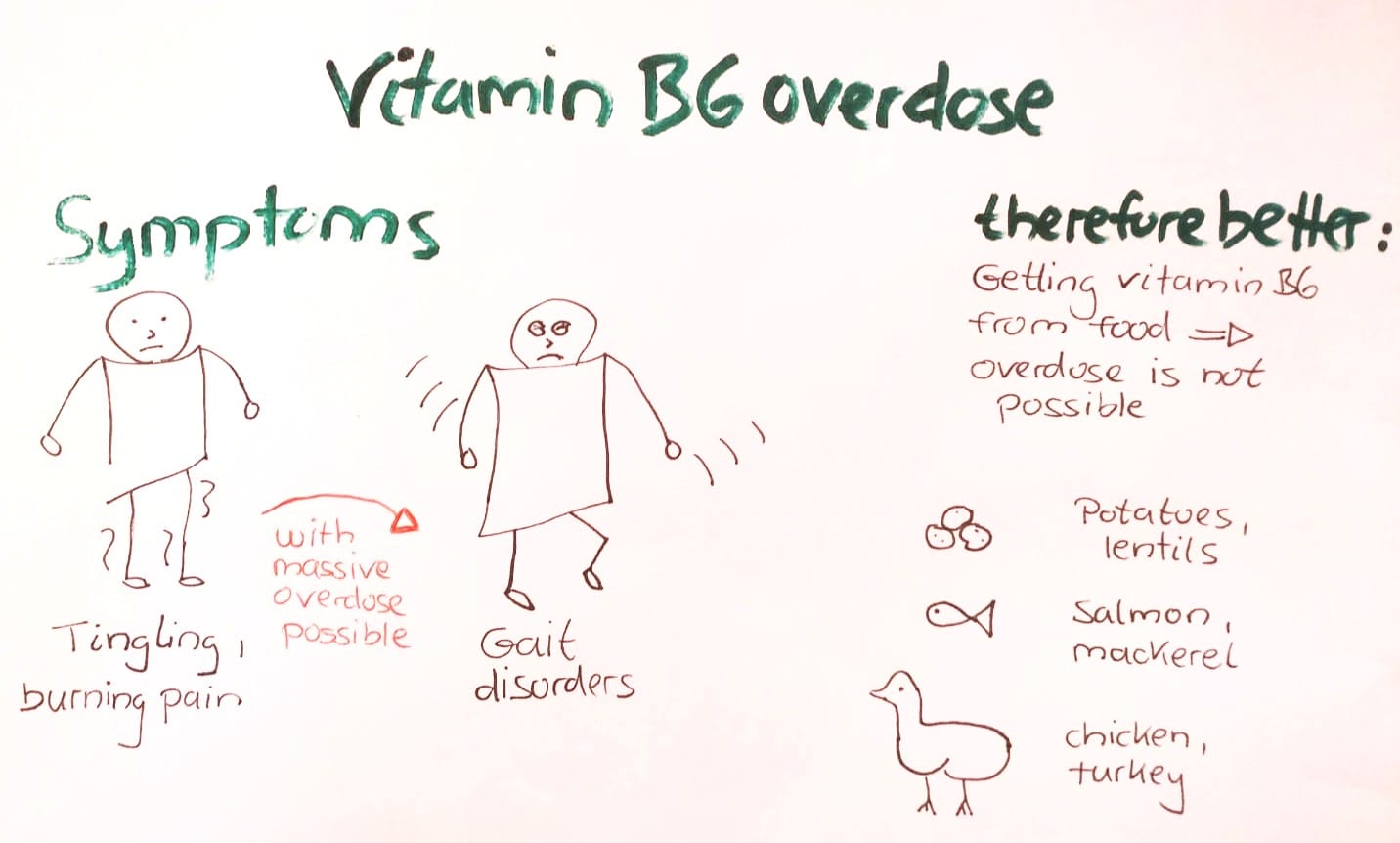
The classic presentation of pyridoxine toxicity is peripheral sensory neuropathy, involving:
- Numbness in a stocking-glove distribution
- Burning and tingling in the extremities
- Impaired vibration sense
- In severe cases: gait disturbances and ataxia
- Less commonly: autonomic dysfunction
Because these symptoms so closely resemble B6 deficiency, some people unfortunately respond by increasing their dose even further. [4]
The role of pyridoxal-5'-phosphate (P5P)
An important practical question: is P5P safer than pyridoxine HCl?
The evidence suggests yes. P5P appears considerably less neurotoxic at typical supplemental doses (up to roughly 100 mg). In the cell studies by Vrolijk et al., P5P showed no toxicity, while pyridoxine HCl damaged cells in a concentration-dependent way. [1] This aligns with epidemiological data too: nearly all documented cases of B6-related neuropathy are associated with pyridoxine HCl, not P5P. [2] [3]
That said, caution is still recommended with P5P at doses above 300 mg daily. [6] At such extremely high doses, other mechanisms (like direct aldehyde toxicity) may become relevant.
Importantly: when a product contains both forms (as many B-complex supplements do), both contribute to total B6 levels, but the risk comes primarily from the pyridoxine HCl component. In a product containing, say, 10 mg pyridoxine HCl plus 10 mg P5P, the total dose is 20 mg, but the 10 mg of pyridoxine HCl is the more concerning portion.
The long half-life: why stopping the supplement does not help right away
Another critical, often overlooked point: B6 accumulates in muscle tissue and nerve tissue.
Once stopped, it can take months for B6 to fully clear the body. [2] [4] This explains why, in the case described above, toxic blood levels were still detectable a full week after stopping the supplement.
Symptoms can therefore persist even after stopping, though they generally improve over time. In rare cases of massive overdose, some neurological damage appears to remain permanent. [4]
What does this mean in practice?
Given how often this pattern shows up, including at doses that are widely and easily available through retail, Amazon, or standard supplement products, stronger patient education on this topic feels genuinely necessary.
Based on the current scientific literature, the following recommendations apply:
- Before starting B6 supplementation: get blood levels tested.
- While supplementing: get regular monitoring, especially at doses above 10 mg daily.
- Check your products: many patients unknowingly take multiple B6-containing products (multivitamins, magnesium supplements, B-complexes). These doses add up.
- Favor P5P over pyridoxine HCl where possible, though caution is still warranted at high doses even with P5P.
- If neurological symptoms develop while taking B6: stop immediately and get levels checked.
- Patient education matters: many people don't realize that "natural" vitamins aren't automatically harmless.
References
[1] Vrolijk MF, Opperhuizen A, Jansen EHJM, Hageman GJ, Bast A, Haenen GRMM. The vitamin B6 paradox: Supplementation with high concentrations of pyridoxine leads to decreased vitamin B6 function. Toxicol In Vitro. 2017 Oct;44:206-212.
https://pubmed.ncbi.nlm.nih.gov/28716455/
[2] Hadtstein F, Vrolijk M. Vitamin B-6-Induced Neuropathy: Exploring the Mechanisms of Pyridoxine Toxicity. Adv Nutr. 2021 Oct 1;12(5):1911-1929.
Umfassendes Review zu konkurrierenden Hypothesen des Toxizitätsmechanismus
https://www.ncbi.nlm.nih.gov/pmc/articles/PMC8483950/
[3] Australian Therapeutic Goods Administration (TGA). Peripheral neuropathy with supplementary vitamin B6 (pyridoxine). Medicines Safety Update, July 2023.
https://www.tga.gov.au/news/safety-updates/peripheral-neuropathy-supplementary-vitamin-b6-pyridoxine
[4] Hemminger A, Wills B. Vitamin B6 Toxicity. StatPearls [Internet]. Treasure Island (FL): StatPearls Publishing; 2023.
https://www.ncbi.nlm.nih.gov/books/NBK554500/
[5] Kościńska-Shukla I, et al. Underestimated pyridoxine consumption and neurotoxicity: a novel manifestation with rheumatologic relevance - a case-based review. Clin Rheumatol. 2025.
https://pmc.ncbi.nlm.nih.gov/articles/PMC12106547/
[6] Bayat A, et al. Pyridoxine or pyridoxal-5'-phosphate treatment for seizures in glycosylphosphatidylinositol deficiency: A cohort study. Dev Med Child Neurol. 2022;64(6):739-747.
doi:10.1111/dmcn.15142