

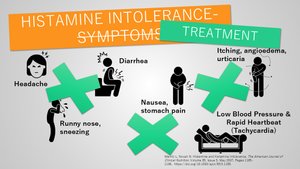
The mechanisms that lead to and trigger histamine intolerance are still only partly understood. What is currently known about how it develops is covered in a separate article on the causes of this condition, also referred to in scientific literature as histamine sensitivity or histamine intolerance syndrome (HIS).
Because of the remaining uncertainty around histamine intolerance, there is also no full agreement yet on treatment, and some recommendations are debated. Below, existing recommendations are covered along with their scientific basis, or lack of one, to give both practitioners and patients a clear thread to follow.
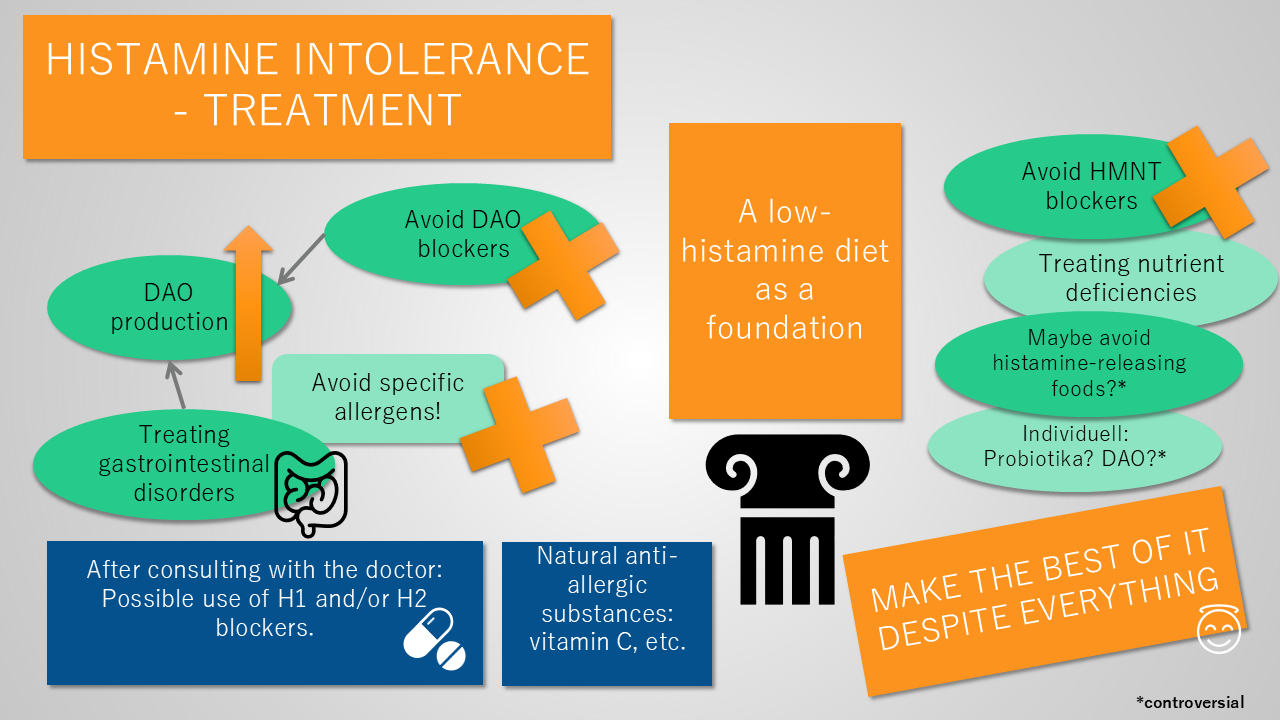
Summary of treatment approaches
Histamine intolerance still is not fully understood, and many treatment options have not been thoroughly studied.
- Low-histamine diet as a baseline therapy
- Avoiding medications that block DAO and HNMT
- Treating other underlying gastrointestinal conditions
- Antihistamines (H1 and, in some cases, H2 blockers, as prescribed by a doctor)
- Correcting nutrient deficiencies (including DAO cofactors like B6)
- Vitamin C
- Trial of DAO supplementation with DAOsin®
- Histamine-degrading probiotics
Low-histamine diet as a baseline therapy
Histamine forms from histidine, an amino acid, and develops in food mainly through bacterial metabolic processes during longer aging, in aged Gouda, for example.
In people with histamine intolerance, the balance between histamine breakdown and intake (see causes) is disrupted. Reducing dietary histamine intake can help prevent histamine-triggered symptoms. Foods should ideally be prepared fresh and eaten right away, to limit histamine formation.
Since the degree of aging, and therefore histamine formation, depends on many factors beyond the food itself, such as the cold chain during transport or general freshness, food lists are often not that helpful. In the author's experience, they can actually backfire: people end up avoiding foods that would have been fine for them, which can lead to nutrient deficiencies or calorie shortfalls.
Ground beef, for example, might be well tolerated one time, since chilled storage and quick consumption kept histamine levels low. Another time, poor storage or transport in warm conditions may have allowed protein-degrading bacteria to become more active, increasing histamine formation to the point where it triggers symptoms.
Tolerance thresholds also vary widely across the patient population. For severely affected individuals, even fresh ground beef can contain too much histamine.
Individual tolerance depends on many other factors too, which makes blanket rules unhelpful here as well. In women, tolerance often fluctuates across the menstrual cycle, and certain medications can shift the symptom threshold.
A note on this content: This article covers a health topic. It is important to have your symptoms evaluated and treated by a qualified healthcare professional. This article cannot replace, and is not intended to replace, care and guidance from a professional.
Considering medications
Histamine in the body is broken down mainly by two enzymes: diamine oxidase, abbreviated DAO, and histamine N-methyltransferase (HNMT). [1] The detailed breakdown pathways for histamine and other biogenic amines are covered in the article on the causes of histamine intolerance.
Some medications affect the activity of DAO or HNMT, the enzymes needed for histamine breakdown. These can worsen histamine intolerance, so it's worth discussing alternatives with your treating doctor, especially if genetic variants that already reduce enzyme activity are present.
Treating other underlying gastrointestinal conditions
Other gastrointestinal conditions can lead to increased histamine production, small intestinal bacterial overgrowth (SIBO), for example, where bacteria overgrow in the small intestine, is one such condition.
Other conditions reduce the amount of diamine oxidase (DAO) available in the intestinal lining below what's needed for histamine breakdown. This is the case with gastrointestinal allergies and chronic inflammatory bowel diseases, both of which can trigger or worsen histamine intolerance. [2] [3]
Treating the underlying condition can lead to an improvement in histamine intolerance symptoms.
DAO cofactors: B6 and copper?
Vitamin B6 and copper are cofactors for diamine oxidase (DAO) and are needed for it to break down histamine efficiently. However, studies specifically on supplementing them for histamine intolerance are still lacking. [1]
Deficiencies can be identified through blood tests.
In the absence of an actual deficiency, the benefit is questionable in the author's view. The supplements marketed as DAO cofactors, often bought by desperate patients, mostly benefit supplement manufacturers.
Vitamin B6 for histamine intolerance?
Taking vitamin B6 when a deficiency is present can be beneficial, but regular monitoring is important during supplementation, since vitamin B6 also promotes the conversion of histidine into histamine. It stimulates the process carried out by histidine decarboxylase, the enzyme responsible for that conversion. In very high doses, vitamin B6 can even become toxic and trigger polyneuropathy (nerve pain, tingling, and burning, especially in the hands and feet). [6]
B6 may also play a role in allergic symptoms through its involvement in producing the amino acid taurine.
Taking copper for histamine intolerance?
Copper and vitamin C are also considered DAO cofactors. Copper should not be supplemented for DAO optimization without a confirmed deficiency either. There is a risk of overdosing on the one hand, and of disrupting the balance with other trace elements on the other.
Copper and zinc levels, for example, influence each other and can affect how well each is absorbed. This means unnecessary copper supplementation could worsen or contribute to an existing zinc deficiency. [7]
Finally, there is a copper storage disorder called Wilson's disease, in which copper intake is absolutely contraindicated.
Treating nutrient deficiencies in histamine intolerance
Nutrient intake deserves particular attention in more severely affected patients. Even with a restricted diet, deficiencies should not be allowed to develop. If deficiencies are already present, especially when gut conditions or other issues make broad food intake and nutrient absorption difficult, they should be corrected. This includes the usual suspects: vitamin D, iron, zinc, folate, B12, and B6.
Zinc in histamine intolerance
In clinical practice, zinc deficiencies show up repeatedly in patients with gut conditions or a heavily restricted diet. Histamine intolerance often rules out many animal proteins and other foods that are major zinc sources, making it hard to meet daily requirements.
Zinc can be helpful in allergic conditions, as shown in a study on allergic rhinitis (hay fever). [8] Generally, zinc appears to reduce the release of histamine and leukotrienes from mast cells and basophils. [9] This means fewer of the messenger molecules responsible for allergic symptoms get released, which can improve how patients feel.
DAO supplementation (DAOsin®) for histamine intolerance: does it work?
Diamine oxidase, needed for histamine breakdown, can also be taken as a supplement. The company Stada markets a product called DAOsin®, which is heavily promoted for use in histamine intolerance.
According to one study, taking DAO with meals, using DAOsin®, for example, can reduce symptoms. [10] However, the study was very small, and its findings have been questioned by experts, which is why this recommendation has not yet been included in the clinical guideline. [11]
DAOsin and most standard products on the market contain 4.2 mg of DAO extract, typically derived from porcine kidney, the dose used in the previous study and the one currently discussed in clinical guidelines. Plant-based DAO supplements, extracted from pea sprouts (Pisum sativum), have since become available as well, often at higher doses. Some patients report better results with these higher-dose plant-based products compared to standard-dose porcine DAO, though it is worth being clear about what the evidence currently shows.
Research in this area is still developing. A randomized, placebo-controlled trial currently underway at the University of Barcelona [22] is directly comparing porcine-derived DAO against plant-based DAO at two different doses (4.2 mg and 8.4 mg), alongside a low-histamine diet. A separate dose-escalation safety study [23] has tested plant-based DAO at doses up to 67.2 mg, well above what is found in standard products like DAOsin, and found it safe and well tolerated. What is still missing is a completed head-to-head efficacy comparison. So while the idea that a higher dose could break down more histamine is biologically plausible, and matches what some patients report anecdotally, it has not yet been confirmed by a finished comparative trial. That evidence is expected in the next few years as these ongoing studies report their results.
Daily intake, dosage, and side effects of DAOsin®
According to the package insert, DAOsin® can be taken daily. The maximum dose is three capsules per day and should not be exceeded. No serious side effects have been reported, though research on the product remains limited. For this reason, it is not generally recommended.
Patients with a mast cell disorder and/or multiple allergies should be cautious and carefully check any medication or supplement for potential allergens or poorly tolerated ingredients.
Antihistamines for histamine intolerance
Do antihistamines make sense for histamine intolerance? An antihistamine (singular) is a medication or substance that prevents histamine from binding to its receptor, essentially, a histamine receptor blocker.
Histamine is still present in the body, but can no longer exert its usual effects, including the ones that trigger symptoms. This eases histamine-mediated symptoms like a runny nose, sneezing, and similar reactions.
There are several different histamine receptors in the body. Since the H1 receptor is primarily responsible for histamine's allergic symptoms, classic antihistamines are generally H1 blockers.
H1 blockers include active ingredients like loratadine (Lorano®), cetirizine, and fexofenadine (Allegra®). These can be used for occasional dietary slip-ups or more severe symptoms attributable to histamine intolerance, and this is supported by clinical guidelines. [11] Fexofenadine in particular crosses the blood-brain barrier only minimally, which makes it markedly less sedating than older antihistamines, a useful distinction for anyone who needs to stay alert during the day.
Histamine has several different receptors, though, and not all of them can currently be blocked with medication. H2 blockers, which play a role in stomach acid production (prescription only, under medical supervision), can be tried when heartburn or nausea are the main symptoms. [11]
The following approaches do not yet have clear guideline-backed recommendations for histamine intolerance, but patients try them anyway:
Vitamine C for histamine intolerance
Oxidative stress is one of the key factors behind allergy symptoms. Vitamin C is one of the most powerful antioxidants available. Its role in preventing asthma attacks and allergic symptoms is discussed repeatedly in the literature.
Even though a 2009 Cochrane review concluded that vitamin C couldn't yet be recommended for treating asthma due to insufficient evidence, there are indications that it can have a positive effect on allergic processes. [18]
In a placebo-controlled, randomized study, researchers found that vitamin C had a corticosteroid-sparing effect. Asthma patients who took 1 gram of vitamin C per day were able to statistically significantly reduce their cortisone use and benefited from the supplementation. [19]
Intravenous vitamin C is particularly interesting, since it achieves supraphysiological levels (concentrations that don not otherwise occur in nature), allowing for comparatively high doses, 7.5 grams (!), for instance. Most people taking such a high dose orally through the digestive tract would experience very uncomfortable diarrhea.
Research on vitamin C and histamine
In study participants who received intravenous vitamin C, serum histamine levels were shown to decrease. A 2018 observational study impressively showed that patients with underlying allergic conditions often benefited significantly, in terms of symptoms, from intravenous vitamin C. [20] [21]
There is often considerable skepticism, particularly from doctors, when intravenous vitamin C comes up. It is certainly not the miracle cure it is sometimes made out to be, but many mast cell and allergy patients report a genuine improvement in quality of life because of it, and clinicians who work closely with this patient group describe the results as consistently better than expected.
Some patients also describe benefiting specifically from an extended-release form like CeTeBe®, which can improve allergic or histamine-mediated symptoms. In people with severe organic acid intolerance, however, both oral and intravenous vitamin C can be poorly tolerated.
Probiotics for histamine intolerance
A disrupted gut barrier (sometimes called "leaky gut") increases the uptake of additional allergens from food and contributes to a heightened inflammatory response in the body. [12] If allergic reactions in the gut lining still play a role in histamine intolerance, it makes sense to try to limit them. [2]
Some probiotics have been used successfully in studies for atopic eczema and were able to positively influence gut permeability, the medical term for how easily substances pass through the intestinal lining, often called "leaky gut" in complementary medicine.
One probiotic shown in a study to have a positive effect on the gut lining is Lactobacillus rhamnosus GG. [13] That study, however, has also faced significant criticism for its short duration, small sample size, and methodological weaknesses. [14]
Probiotic studies often have limited statistical power due to study design, small participant numbers, and lack of randomization. Some are funded by probiotic manufacturers. That is not necessarily a problem in itself, but there is a general publication bias in science, meaning mostly what works ends up getting published.
Probiotics can produce histamine too
When choosing a probiotic, it makes sense to avoid ones containing L. reuteri, L. bulgaricus, or L. casei, though it is worth stressing clearly that this depends on the specific strain, not the species as a whole. (Biogenic amine and histamine production was demonstrated specifically for Lactobacillus casei (TISTR 389) and Lactobacillus delbrueckii subsp. bulgaricus (TISTR 895), not for other strains. [15]) This is why most good-quality probiotics list the specific strain on the label.
Which probiotics make sense for histamine intolerance?
In general, probiotics with anti-inflammatory effects make the most sense, ideally ones that may even counteract allergic processes, for example by downregulating the IgE receptor involved in these conditions. Lactobacillus rhamnosus GG is one example. [13] [16]
In a rat model, Bifidobacterium infantis and Bifidobacterium longum also showed positive effects on allergen-induced histamine signaling. [17] As with any animal model, though, it remains an open question how well these findings translate to humans.
Differential diagnoses for histamine intolerance
When symptoms are especially severe and cannot be traced back to histamine-containing foods, mast cell activation syndrome (MCAS) may be worth considering in cases of multisystem symptoms, after ruling out other underlying conditions (chronic inflammatory bowel disease, SIBO, other intolerances, and allergies).
Treatment of related gynecological conditions
Treating premenstrual syndrome (PMS)
When histamine intolerance symptoms are strongly cycle-dependent and especially pronounced in the second half of the cycle, treatment approaches that also address underlying premenstrual syndrome can help.
PMS mainly involves symptoms like breast tenderness, bloating, and insomnia or significant fatigue, which appear after ovulation in the second half of the cycle and resolve once menstruation begins. [4]
Treating endometriosis
Clinicians working with these patients often notice an anecdotal overlap between food intolerances and endometriosis, and there also appear to be genuine connections that are not yet fully understood.
Both conditions involve heightened hypersensitivity, meaning pain and other stimuli are perceived more intensely. While there are some indications that diet may play a role in endometriosis, and not only through its effect on irritable bowel syndrome, research on these connections is still in its early stages, so recommendations remain cautious. [5]
Conversations with patients, doctors, and specialists treating chronic pelvic pain, irritable bowel syndrome, and endometriosis suggest that some endometriosis patients seem to benefit considerably from reducing histamine intake.
The existing research and other evidence pointing toward mast cell overactivity, endometriosis, and interstitial cystitis is summarized separately in its own article, given the complexity of the topic.
References
[1] Maintz L, Novak N. Histamine and histamine intolerance. Am J Clin Nutr. 2007;85(5):1185-1196. doi:10.1093/ajcn/85.5.1185
[2] Raithel M, Küfner M, Ulrich P, Hahn EG. The involvement of the histamine degradation pathway by diamine oxidase in manifest gastrointestinal allergies. Inflamm Res Off J Eur Histamine Res Soc Al. 1999;48 Suppl 1:S75-76. doi:10.1007/s000110050414
[3] Petersen J, Raithel M, Schwelberger HG. Histamine N-methyltransferase and diamine oxidase gene polymorphisms in patients with inflammatory and neoplastic intestinal diseases. Inflamm Res Off J Eur Histamine Res Soc Al. 2002;51 Suppl 1:S91-92. doi:10.1007/pl00022464
[4] Royal College of Obstestricians and Gynaecologists. Management of Premenstrual Syndrome. BJOG Int J Obstet Gynaecol. 2017;124(3):e73-e105. doi:10.1111/1471-0528.14260
[5] Issa B, Ormesher L, Whorwell PJ, Shah M, Hamdy S. Endometriosis and irritable bowel syndrome: a dilemma for the gynaecologist and gastroenterologist. Obstet Gynaecol. 2016;18(1):9-16. doi:10.1111/tog.12241
[6] Vrolijk MF, Opperhuizen A, Jansen EHJM, Hageman GJ, Bast A, Haenen GRMM. The vitamin B6 paradox: Supplementation with high concentrations of pyridoxine leads to decreased vitamin B6 function. Toxicol Vitro Int J Publ Assoc BIBRA. 2017;44:206-212. doi:10.1016/j.tiv.2017.07.009
[7] Jumaan RM. Serum Copper, Zinc and Copper/Zinc Ratio and their Relationship to Age and Growth Status in Yemeni Adolescent Girls. Sultan Qaboos Univ Med J. 2008;8(3):291-299. Accessed July 16, 2026. https://www.ncbi.nlm.nih.gov/pmc/articles/PMC3074839/
[8] Dewi, Anna M., Setyorini, Dian I., Suriphati. Frontiers | The effect of zinc supplementation on the improvement of clinical symptoms and the quality of life of persistent moderate severe allergic rhinitis patients. Accessed July 2, 2020. https://www.frontiersin.org/10.3389/conf.fphar.2018.63.00084/event_abstract
[9] Marone G, Columbo M, de Paulis A, Cirillo R, Giugliano R, Condorelli M. Physiological concentrations of zinc inhibit the release of histamine from human basophils and lung mast cells. Agents Actions. 1986;18(1-2):103-106. doi:10.1007/BF01987995
[10] Komericki P, Klein G, Reider N, et al. Histamine intolerance: lack of reproducibility of single symptoms by oral provocation with histamine: a randomised, double-blind, placebo-controlled cross-over study. Wien Klin Wochenschr. 2011;123(1-2):15-20. doi:10.1007/s00508-010-1506-y
[11] Reese I, Ballmer-Weber B, Beyer K, et al. German guideline for the management of adverse reactions to ingested histamine: Guideline of the German Society for Allergology and Clinical Immunology (DGAKI), the German Society for Pediatric Allergology and Environmental Medicine (GPA), the German Association of Allergologists (AeDA), and the Swiss Society for Allergology and Immunology (SGAI). Allergo J Int. 2017;26(2):72-79. doi:10.1007/s40629-017-0011-5
[12] Perrier C, Corthésy B. Gut permeability and food allergies. Clin Exp Allergy J Br Soc Allergy Clin Immunol. 2011;41(1):20-28. doi:10.1111/j.1365-2222.2010.03639.x
[13] Grüber C, Wendt M, Sulser C, et al. Randomized, placebo-controlled trial of Lactobacillus rhamnosus GG as treatment of atopic dermatitis in infancy. Allergy. 2007;62(11):1270-1276. doi:10.1111/j.1398-9995.2007.01543.x
[14] Rhein, A. LACTOBACILLUS GG BEI ATOPISCHER DERMATITIS? - arznei telegramm. Accessed July 16, 2026. https://www.arznei-telegramm.de/html/2004_05/0405050_01.html
[15] Deepika Priyadarshani WM, Rakshit SK. Screening selected strains of probiotic lactic acid bacteria for their ability to produce biogenic amines (histamine and tyramine): Screening selected strains of probiotic lactic acid bacteria. Int J Food Sci Technol. 2011;46(10):2062-2069. doi:10.1111/j.1365-2621.2011.02717.x
[16] Spiller R. Review article: probiotics and prebiotics in irritable bowel syndrome. Aliment Pharmacol Ther. 2008;28(4):385-396. doi:10.1111/j.1365-2036.2008.03750.x
[17] Dev S, Mizuguchi H, Das AK, et al. Suppression of Histamine Signaling by Probiotic Lac-B: a Possible Mechanism of Its Anti-allergic Effect. J Pharmacol Sci. 2008;107(2):159-166. doi:10.1254/jphs.08028FP
[18] Kaur B, Rowe BH, Arnold E, Arnold E. Vitamin C supplementation for asthma. Cochrane Database Syst Rev. 2009;2009(1). doi:10.1002/14651858.CD000993.pub3
[19] Fogarty A, Lewis SA, Scrivener SL, et al. Corticosteroid sparing effects of vitamin C and magnesium in asthma: a randomised trial. Respir Med. 2006;100(1):174-179. doi:10.1016/j.rmed.2005.03.038
[20] Hagel AF, Layritz CM, Hagel WH, et al. Intravenous infusion of ascorbic acid decreases serum histamine concentrations in patients with allergic and non-allergic diseases. Naunyn Schmiedebergs Arch Pharmacol. 2013;386(9):789-793. doi:10.1007/s00210-013-0880-1
[21] Vollbracht C, Raithel M, Krick B, Kraft K, Hagel AF. Intravenous vitamin C in the treatment of allergies: an interim subgroup analysis of a long-term observational study. J Int Med Res. 2018;46(9):3640-3655. doi:10.1177/0300060518777044
[22] Duelo A, Sánchez-Pérez S, Ruiz-Leon AM, et al. Study Protocol for a Prospective, Unicentric, Double-Blind, Randomized, and Placebo-Controlled Trial on the Efficacy of a Low-Histamine Diet and DAO Enzyme Supplementation in Patients with Histamine Intolerance. Nutrients. 2025;17(1):29. doi:10.3390/nu17010029
[23] AB Biotek, Hospital Clínic de Barcelona. Kinetic Study of Supplementation with the Enzyme Diamine Oxidase in Patients with Histamine Intolerance. ClinicalTrials.gov identifier: NCT07006558. Registered 2025.