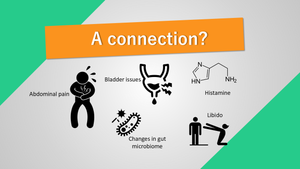
Mast cells are not just concentrated in the diencephalon, the part of the brain involved in emotional regulation, they are also found in high numbers in the bladder, prostate, penis, vagina, and uterus, even though allergic reactions rarely occur in these organs.
So what role do mast cells play in the urogenital tract, specifically in the bladder and reproductive organs? And what does this mean for understanding the overlap between irritable bowel syndrome, chronic pelvic pain, endometriosis, and interstitial cystitis?
Mast cells can release substances that contract muscle tissue, dilate blood vessels, and promote inflammation, which can, for example, trigger uterine contractions. Growing evidence points to mast cells playing a role in chronic, painful bladder conditions like interstitial cystitis (IC), in endometriosis, and in non-bacterial, non-viral prostatitis. [1]
The role of mast cells in endometriosis
In endometriosis, tissue resembling the uterine lining establishes itself elsewhere in the abdominal cavity. This tissue builds up monthly under hormonal influence and bleeds along with menstruation. Depending on the size of these lesions, this can lead to blood or fluid accumulation in the abdominal cavity. The condition can cause severe pain and significantly affect patients' work and relationships.
One study found an increased number of mast cells, some already degranulated (meaning they had already released inflammatory mediators like histamine and leukotrienes), specifically in the endometriosis tissue of severely affected patients (stage IV, deeply infiltrating disease).
The researchers behind this study believe the number of degranulated mast cells may play a role in how pain is experienced, since these cells were most common in patients with the most severe pain. For patients with a higher number of mast cells, endometriosis appears to be especially painful. [2]
A connection between mast cells and the nerve cells that transmit pain signals has already been demonstrated at many sites throughout the body. Nerves and mast cells also work together in mediating itch. [3] [4]
Stress hormones negatively affect endometriosis and mast cells
In a rat model, stress was shown to worsen endometriosis. [5] Stress triggers the release of hormones and mediators that affect the immune system. Hormonally, this involves increased release of the stress hormone CRH (corticotropin-releasing hormone) from the hypothalamus, which acts through the pituitary gland to stimulate the adrenal glands to release more cortisol and adrenaline.
Mast cells carry CRH receptors and respond to increased levels of this hormone. This is one of the mechanisms through which increased stress can lead to greater mast cell degranulation. The mediators released can include not just histamine but also growth factors, which can be particularly unfavorable in the tissue surrounding endometriosis lesions, since they may promote the formation of new lesions.
Because of this, relaxation techniques and mindfulness training can be genuinely helpful for people with mast cell activation and chronic pain, as a way to ease inflammatory responses. Articles on hypnosis for autoimmune conditions, and for allergies and histamine-mediated conditions, cover the connection between stress and immune function in more depth.
Histamine can affect menstrual pain
Mast cells release a wide range of mediators. The most important ones are covered in more detail in the article on mast cell conditions.
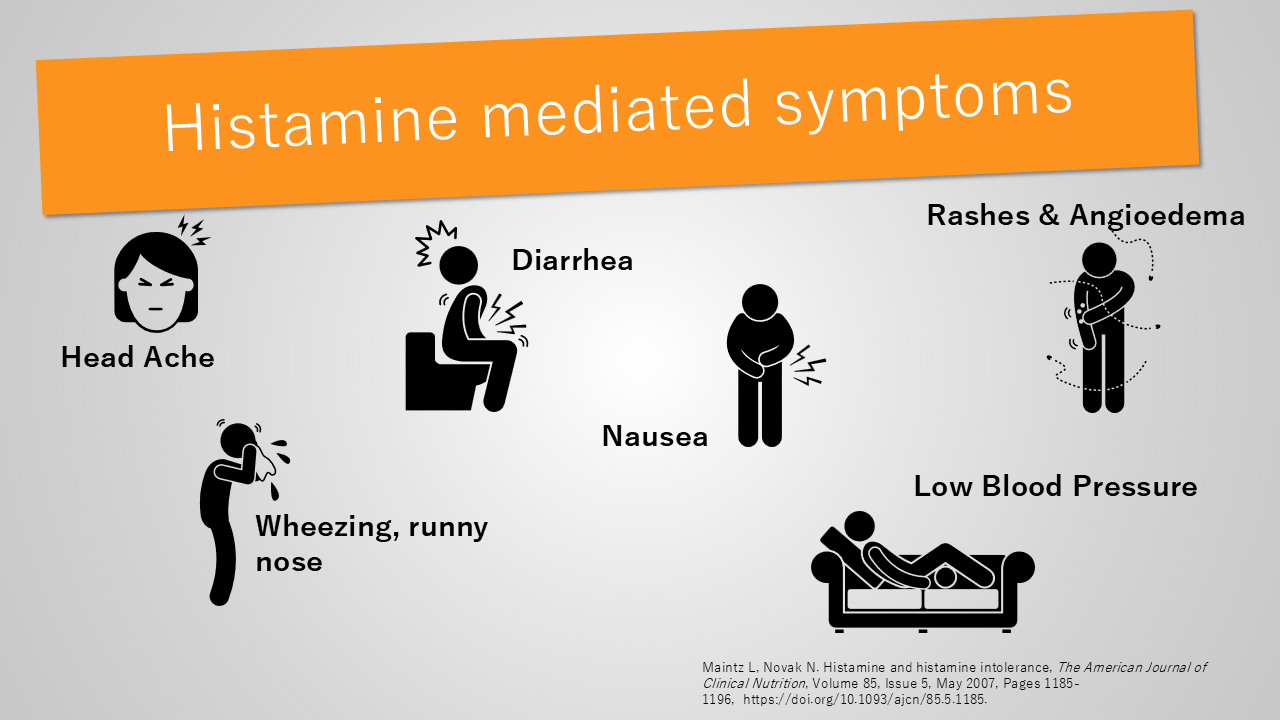
One of these mediators is histamine, which can lower the pain threshold. This means pain isn't just perceived as more intense, local inflammatory responses can also be worsened by histamine and other mediators. [6] Because of this, some patients with menstrual pain, medically known as dysmenorrhea, benefit from a low-histamine diet.
Histamine intolerance syndrome (HIS), mast cell activation syndrome (MCAS), and other intolerances sometimes occur alongside endometriosis, which makes thorough differential diagnosis particularly important here.
Bladder issues, pelvic pain, and interstitial cystitis (IC)
Chronic pelvic discomfort, pelvic pain, and bladder or pelvic floor symptoms often occur together or are closely linked. This is not surprising, since constant bladder pain and urinary urgency can lead to pelvic floor tension, which can then cause additional pain of its own.
Long-lasting pain during urination without signs of infection, very frequent urination, strong urinary urgency, and, over time, a possible decrease in bladder capacity are all symptoms of interstitial cystitis (IC).
Mast cells may play a significant role in IC, since they appear more frequently in the bladder tissue of affected patients. Accordingly, medications like antihistamines, which block histamine's effects at the H1 receptor, are sometimes used as treatment.
Certain autoantibodies are also suspected of contributing to IC, meaning the immune system mistakenly targets the body's own cells or tissue components, a pattern known as an autoimmune condition.
Overall, more IC patients are female. Autoimmune conditions occur more frequently not just in these patients themselves, but also within their families.
One antibody in particular is suspected of playing a causal role in this painful condition: the muscarinic M3 receptor antibody, which is especially common in patients with Sjögren's syndrome, an autoimmune condition. [7]
When patients also have a mast cell condition like MCAS, allergies, or other intolerances, treating these underlying conditions often improves IC symptoms as well. A low-histamine diet can also help when histamine intolerance syndrome is present.
Ruling out an underlying intolerance or allergy in patients with irritable bowel symptoms is particularly important, since there are known interactions between the gut and bladder. Similar to patients with irritable bowel syndrome, people with interstitial cystitis also show notable differences in their gut microbiome, including significantly reduced levels of Eggerthella sinensis, Faecalibacterium prausnitzii, and Lactonifactor longoviformis. [8]
The influence of sex hormones on mast cells
Mast cells also carry sex hormone receptors, meaning hormones beyond CRH can trigger mast cell degranulation as well. This appears to be particularly true for estrogen. [9]
At least in rat ovaries, the upstream hormones LH (luteinizing hormone) and FSH (follicle-stimulating hormone) also increase mast cell degranulation. LH and FSH are involved in, among other things, stimulating the ovaries or testes. [9]
Human mast cells, on the other hand, carry testosterone and progesterone receptors, which appear to have more of a stabilizing effect on mast cells, though, as with estrogen, the full role of these hormones is not yet completely understood.
Mast cells and histamine: an influence on libido and sexual arousal?
Mast cell mediators, the substances released by mast cells, play a role in sexual arousal. Histamine in particular seems to stand out in this process and appears to act as a kind of aphrodisiac for some individuals.
According to mast cell researcher Prof. Theoharides and his colleague Stewart, this may explain anecdotal reports from patients with heightened mast cell activity experiencing an increased sex drive. [1]
One thing is certain, though: libido, sex drive, and everything else involved in human connection can't be fully explained by mast cells or hormones alone, but the connections that do exist are worth paying attention to. 😉
Conclusion
For patients with chronic pelvic pain, thorough differential diagnosis is essential. In female patients, endometriosis should be considered, especially when the pain follows a cyclical pattern that correlates with menstruation.
Interstitial cystitis should also be considered in cases of chronic pain during urination without a bacterial infection, along with urinary urgency and bladder pain, particularly when an autoimmune condition or mast cell disorder is also present. In these cases, a tailored diet and treatment approach aimed at reducing mast cell mediator release may be worth trying.
These conditions can also occur alongside irritable bowel syndrome, and it is not unusual for this particular patient group to be dealing with several overlapping conditions at once.
Collaboration between the relevant specialties, gynecology, urology, allergology, and gastroenterology, is essential. For autoimmune conditions within the rheumatic disease spectrum, coordinating with a treating rheumatologist can also be an important part of reducing overall disease burden.
References
[1] Theoharides TC, Stewart JM. Genitourinary mast cells and survival. Translational Andrology and Urology. 2015;4(5):579-586-586. Accessed October 26, 2018. http://tau.amegroups.com/article/view/8089
[2] Anaf V, Chapron C, El Nakadi I, De Moor V, Simonart T, Noël JC. Pain, mast cells, and nerves in peritoneal, ovarian, and deep infiltrating endometriosis. Fertil Steril. 2006;86(5):1336-1343. doi:10.1016/j.fertnstert.2006.03.057
[3] Gupta K, Harvima IT. Mast cell-neural interactions contribute to pain and itch. Immunol Rev. 2018;282(1):168-187. doi:10.1111/imr.12622
[4] Babina M. The pseudo-allergic/neurogenic route of mast cell activation via MRGPRX2: discovery, functional programs, regulation, relevance to disease, and relation with allergic stimulation. Itch. 2020;5(2):e32. doi:10.1097/itx.0000000000000032
[5] Cuevas M, Flores I, Thompson KJ, Ramos-Ortolaza DL, Torres-Reveron A, Appleyard CB. Stress Exacerbates Endometriosis Manifestations and Inflammatory Parameters in an Animal Model. Reprod Sci. 2012;19(8):851-862. doi:10.1177/1933719112438443
[6] Obara I, Telezhkin V, Alrashdi I, Chazot PL. Histamine, histamine receptors, and neuropathic pain relief. Br J Pharmacol. 2020;177(3):580-599. doi:10.1111/bph.14696
[7] Van De Merwe, P J. Interstitial cystitis and systemic autoimmune diseases. Nat Rev Urol. 2007;4(9):484-491. doi:10.1038/ncpuro0874
[8] Braundmeier-Fleming A, Russell NT, Yang W, et al. Stool-based biomarkers of interstitial cystitis/bladder pain syndrome. Sci Rep. 2016;6:26083. doi:10.1038/srep26083
[9] Zierau O, Zenclussen AC, Jensen F. Role of female sex hormones, estradiol and progesterone, in mast cell behavior. Front Immunol. 2012;3. doi:10.3389/fimmu.2012.00169