
Omega-3 fatty acids are among the most hyped, and most widely taken, supplements out there, especially when it comes to silent, chronic inflammation.
The science backs this up, and for allergies and mast cell conditions specifically, there are some genuinely promising findings that also hold up in clinical experience with patients. A recently published, large-scale comparative study by Khabir et al. (DOI: 10.1080/10408398.2026.2615693) gives us a good reason to take a closer look at this topic.
Many of you have probably experienced this: taking omega-3 capsules and noticing either no effect at all, or side effects you didnot expect. Part of the reason is that inflammation in the body is genuinely complex. Everyone brings their own unique pattern of immune activation, nervous system function, gut health, fatty acid metabolism, and individual triggers to the table.
A quick detour into fatty acid metabolism
Fats contain two major groups of unsaturated fatty acids that are especially relevant to inflammation: omega-3 and omega-6 fatty acids. Both have one or more double bonds in their chemical structure, making them more reactive and biologically active than saturated fatty acids.
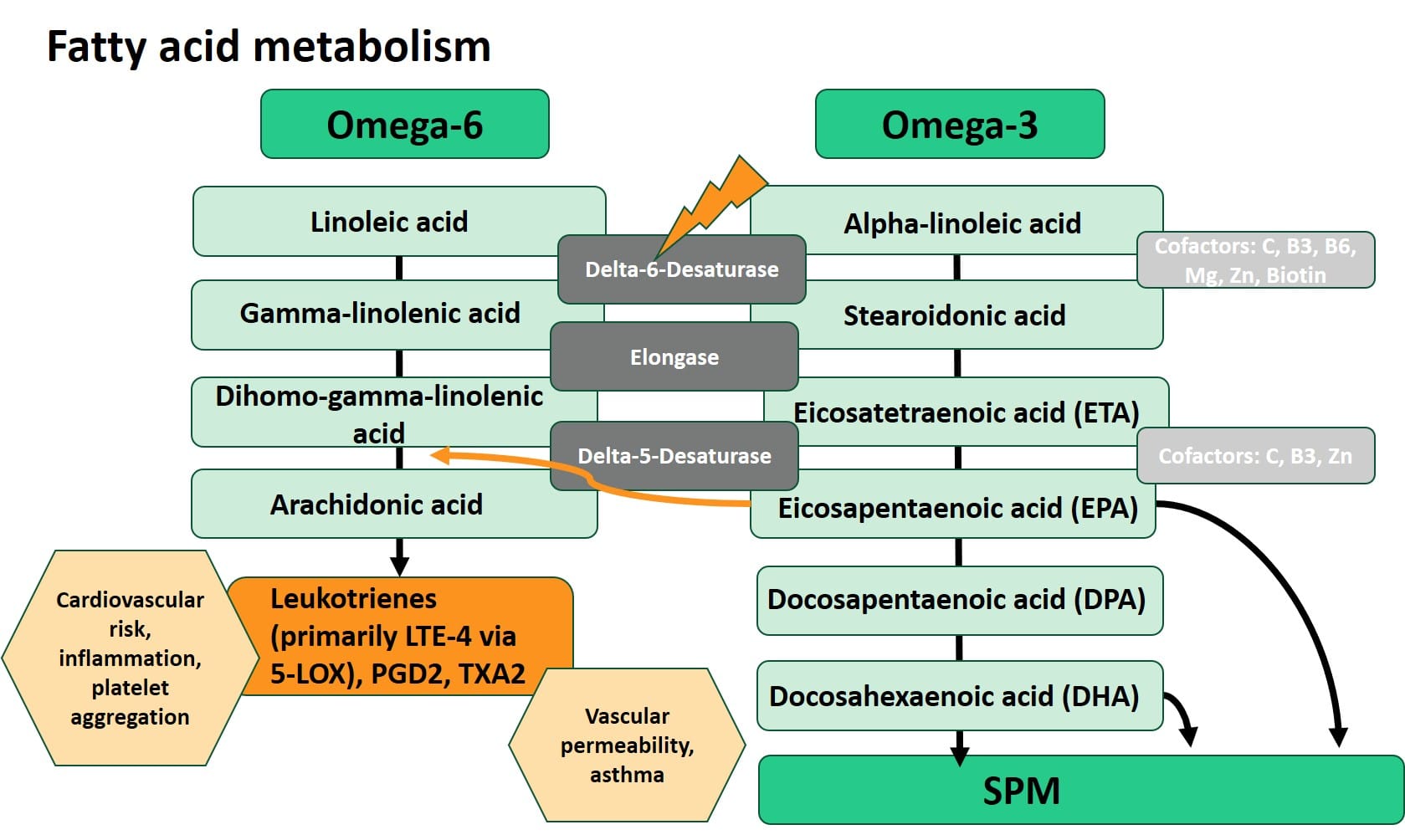
Omega-6 fatty acids are broken down, through a series of enzymes, into arachidonic acid, which is pro-inflammatory. Arachidonic acid, in turn, gets converted by further enzymes into inflammatory mediators, leukotrienes, prostaglandins, and thromboxanes, which activate mast cells, amplify allergic reactions, and contribute to processes like asthma, mucosal inflammation, and chronic inflammatory responses.
Omega-3 fatty acids act as a counterbalance to omega-6. With the help of cofactors and enzymes, they're converted into EPA (eicosapentaenoic acid) and DHA (docosahexaenoic acid). Both compete with arachidonic acid for the same enzymes, shaping how many inflammatory mediators actually get produced. EPA and DHA are further converted into specialized pro-resolving mediators (SPMs), which help the body actively wind down inflammation and regulate overactive immune responses.
Not all omega-3 is created equal
Here is an important point: omega-3 is not just omega-3. And we do not just mean sourcing or product quality here, we mean the ratio between the two key omega-3 fatty acids, EPA and DHA, and the overall dose of the supplement.
The study mentioned above shows that this ratio has received far less attention than it probably deserves. Depending on whether a given product leaned more toward EPA or DHA, researchers found different effects on:
- inflammatory markers like CRP, TNF-alpha, and IL-6
- blood fatty acid composition
- pro-inflammatory omega-6 markers like arachidonic acid
Particularly interesting: products with a higher DHA content led to a stronger reduction in pro-inflammatory cytokines, while products with a higher EPA content mainly reduced arachidonic acid levels.
Most products on the market actually lean toward EPA dominance. Depending on the specific condition and the underlying drivers of chronic inflammation, though, it can genuinely make sense to think carefully about which formulation is most likely to deliver the best results for a given situation.
When fatty acid metabolism itself is disrupted: the mast cell connection
In mast cell conditions and allergies specifically, fatty acid metabolism is not just a theoretical concern, it is often a central player. One example that I, Lisa, have written about extensively elsewhere is salicylate and NSAID intolerance, where arachidonic acid metabolism typically shifts toward leukotriene production, with the expected mast-cell-activating and pro-inflammatory consequences that come with it.
For more on this specific topic, a companion article covers salicylate/NSAID intolerance in depth.
For the omega-3 question, this means: in this particular patient group, "downregulating arachidonic acid" is often an especially important lever, and it is a good argument for not reaching blindly for the first standard EPA/DHA product available.
An often underestimated factor: dose
This study also reinforces just how much the dose used actually matters. While most commercially available products are conservative with their recommended dosing, the researchers concluded that a dose of 1 to 3 g/day (combined EPA+DHA) was necessary for a consistent reduction in inflammatory markers. In clinical practice, measurable therapeutic benefit sometimes only shows up at these higher omega-3 doses, though the individually required dose can vary considerably depending on someone's specific inflammatory profile.
This observation is backed up by another finding from the study: omega-3 supplementation showed somewhat stronger effects in healthy individuals than in people with chronic conditions. One possible explanation is that chronic inflammatory processes alter fatty acid metabolism and immune regulation in complex ways, often requiring higher or more individually tailored doses to see the same effect.
A sample product breakdown
To make the dosing question more concrete, here is a practical example: White Omega Plus by Cellavent, a product that comes up often in the community, provides per daily dose (1 capsule):
- 800 mg total omega-3 fatty acids
- of which 400 mg EPA and 300 mg DHA
- for a combined 700 mg EPA+DHA
- in natural triglyceride form, with a documented low TOTOX value
Looking purely at quality, this is a genuinely solid product. For general maintenance in healthy individuals, this amount of EPA+DHA is more than sufficient and exceeds EU health claim thresholds.
For people dealing with significant chronic inflammation, mast cell conditions, or allergies, though, this daily dose sits at the low end of, or below, the range the Khabir study suggests is needed for a consistent reduction in inflammatory markers (1 to 3 g EPA+DHA). This isn't a question of product quality, it is a question of quantity: anyone following the standard "one capsule daily" label instructions is, in many cases, likely underdosed for a genuinely therapeutic effect.
What does this mean in practice?
Based on the current research and clinical experience, here are some practical recommendations:
- Before starting (higher-dose) therapy: get your baseline tested. An omega-3 index and blood fatty acid profile clarify your current status and EPA/DHA ratio.
- Choose a product based on your inflammatory profile. If classic cytokine markers are the main concern, a DHA-dominant product may make sense. If arachidonic acid/eicosanoid issues are more central (NSAID/salicylate intolerance, an asthma component, for example), an EPA-dominant product may be a better fit.
- Set a realistic dose. Based on the current evidence, 1 to 3 g of EPA+DHA daily is needed for a consistent anti-inflammatory effect. Standard label recommendations often fall well below this.
- Pay attention to quality. Look for a low TOTOX value (freshness), triglyceride form rather than ethyl ester form, and transparent lab testing.
- Watch for interactions. This is especially important with blood-thinning medications and before surgery, always check with a doctor first.
- Start low and go slow with MCAS or histamine intolerance. Watch for problematic additives (carrier oils, and be especially cautious with added lemon or orange oil, gelatin, and the source of vitamin E), and increase the dose gradually to better track your individual response.